
Anthony Jimenez is one of my closest fishing friends — and one of the people I’ve learned the most fly fishing from. We talk flies during the week and fish together most weekends, and I still pick something up from him every time we’re on the water.
He came up on the South Platte like a lot of us did — Eleven Mile Canyon and the Dream Stream, learning to read water over the shoulder of a Peak Fly Shop guide named Peter Byrne. Then he kept driving south. These days he lives twenty minutes from the Arkansas tailwater in Pueblo, guides it as co-founder of Tailwater Outfitters, and ties most of what he fishes.
I wanted to get his brain on the page because he thinks about this water the way I wish more people did: presentation over fly, stealth over distance, and a genuine soft spot for a fall mouse hatch that most guides would never admit to preferring over streamers.
Here’s Anthony, in his own words — unedited.
Origin & Background
You came up fishing California lakes and rivers before landing in Southern Colorado in 2009. When did fly fishing flip from a hobby into the thing you couldn’t live without?
I grew up in the central San Joaquin Valley of California, spin fishing for bass, panfish, and trout in the local lakes, ponds, and sometimes irrigation ditches. Every summer my parents would take the family camping near Kernville, CA and I would get the chance to fish the Kern River using salmon eggs, powerbait, then I evolved to using spinners and eventually on the fly rod. Fly fishing became a real thing for me once I moved to Colorado Springs. Every weekend I would fish the South Platte River, mostly Eleven Mile canyon and then the dream stream. I had a great mentor who was a guide for the Peak Fly Shop - Peter Byrne and he would teach me how to tie flies, I’d listen to his fish/guide stories, and I could pick his brain about fly patterns, fishing scenarios, and then make plans for the upcoming outing on the dream. Often, while on the river with Peter, I would stop fishing and observe Peter fish. I would ask why he mended at that point, why is he putting his drift in that specific location, what does he see in the water that makes him think there is a fish there? What does he look for when trying to spot fish? I was fortunate to have such a mentor and fishing buddy. He did encourage me to consider guiding at some point and I eventually did.
Do you remember your first trout on a fly rod? Where were you, what fly, and what did that fish feel like?
Absolutely! It was on the Kern River during a weekend camping trip with my Dad. It was my first fly rod - a 9 Ft 5 weight Orvis Clearwater with the battenkill reel and I was tossing an elk hair caddis (one of a few flies I had) at age 14. I was wet wading and standing in the middle of the river and casting to a soft seam (not that I knew that it was called a seam back then, I just knew that there had to be a fish there). I kept tossing the fly in there and could see that it was floating through the slow slick spot on the river and all of a sudden a splash happened on the surface. It was a nice rainbow trout that took the fly. Reflecting on that moment I now realize it was more about the presentation than even the fly, and I say that because I had no idea back then what fly to use I just put one on that I thought might work and that I could see. I kept tossing the fly in the zone and hoped something would come and take it and sure enough the fish did! Such a great memory.
Tell us about the first fly you ever tied that actually caught a fish — what was the fly, and what’s the story behind that catch?
It was a red zebra midge and I was fishing it on a standard three fly rig on the dream stream. My fishing buddy Peter Byrne was with me and we had a shot of whiskey together on the Mid March morning on the lower section of the dream. Wasn’t a big fish but still counted as my first fish on my first fly I tied
When you’ve got a day to yourself on the water, where are you headed?
Nowadays, it’s on the Arkansas River Tailwater in Pueblo. I live in Pueblo with my wife and our two dogs and can be on the water wetting a line within 20 minutes so that is where you will find me. This early season, I have been at the Dutch Clark stadium area. I enjoy fishing the holes there and getting those fish to take the baetis and caddis imitations I’ve been throwing to them as of late.
The Waters
South Platte and Arkansas at Pueblo are both home water for you. Which one do you find tougher to fish well, and what makes it tough?
I think they both can be equally tough and easy. It just depends on the time of year and the flows. I think for both fisheries when the flows fluctuate during late spring early summer prior to runoff and then again in the fall when the flows get really low. The fluctuating flows can throw the fish off as they adjust to their changing surroundings. The fluctuating flows can change where the fish are. And trying to identify where those spots are can be tricky (At least for me). In high flows, I think it’s crucial to identify those locations where fish can get the most relief from the current, while staying stealthy and get a sufficient supply of food. At times, those locations are hard to reach in high flows or the water clarity isn’t great, so it becomes important to reach where the fish are, get their attention at the depth they are at. In low flows, I believe it’s the stealthiness of an angler that can make a difference. Working close to the bank, sometimes starting on the bank and not stepping into the water at all, then working out towards the middle. Fishing smaller diameter tippets and fishing natural-colored patterns during low flows can also make a big impact and produce fish.
Ways I approach waters, work in to out, observe as much as I can, try to spot fish before casting, and then how do fish react to my lead fly,or how do they react to my fly on the surface. In tough conditions, I adjust my lead fly, (hi vis/uv colored to then more natural-colored patterns), depth and speed (adjusting weight or bead size to get either down or up on the water column), then size of flies. Start big to then small.
Seasons & Hatches
What’s the most exciting time of year on your home rivers — and what’s hatching that makes it special?
The MOUSE HATCH! In the Fall, or at least that is when I have had the most success with a mouse pattern on the Arkansas River Tailwater section. I absolutely love it! I’ve been able to catch browns and bows on mouse patterns in the Fall. I love how visual it is to toss a mouse pattern and push water on the surface to then be smashed on the surface by a trout. I much prefer it than fishing streamers. I wouldn’t doubt that streamers can be more effective and catch bigger fish but I’d much rather get a grab on the surface with a big mouse pattern
Patterns & Technique
When do you usually find yourself at the vise? Walk us through how you go from an idea to a finished new pattern.
I’m on the vise about every three days. I get inspired by a new color of dubbing, or I like how the fish reacts to a pattern so I then tie up about 4-6 of those flies, then I try to downsize the pattern. Ultimately, I look to make the flies thin, subtle (meaning, if there is a uv collar I don’t want the collar to be too big or bright, just enough to grab the attention), and durable.
What does your go-to nymph rig look like? If I showed up to fish with you tomorrow, what would you tie on for me?
I like the standard three nymph rig with an indicator. I prefer the medium sized oros with two colors indicator. I believe that as long as you watch the indicator intently at all times and especially when it first lands you can detect strikes. I agree that euro nymphing is very effective. I just have more confidence in an indicator rig. When I throw a dry fly, I will have a trailer on it but I prefer to throw just one dry and maybe a second dry trailing. (these are just my personal preferences but I will adjust for my clients based on what they can or can’t do with their rig/cast and how the fish are behaving).
On the standard three nymph rig starting from indicator down to the last fly: Indicator: two colored-medium sized oros indicator (year round) A Split Shot above a blood knot or a triple surgeons to prevent the split shot to slip down to the first/lead fly Lead Fly - Most likely a beaded fly and has some weight to it - (tungsten - 2.8 - 3 mm bead) Middle fly (2 feet away from the lead fly) - I like to have it tied eye to eye and it could be a beaded fly, or a foam back fly last fly (1 foot apart from the middle fly) -smaller sized midge/emerger type pattern
What’s the most common technique mistake you see anglers make on tailwaters like these?
Wading and Presentation: Wading- I like to teach my clients, to work in to out but to approach the water a little more stealthy when possible and not to go straight to the middle of the run to wade in it. Presentation- Trying to cast too far out and using too much line. This is a tricky thing to teach because it is so counter intuitive but if we can shorten the casts and point the cast in the correct direction you can achieve a perfect drift and enough distance to maximize the amount of time the flies are in the strike zone
If you had to fish all season with three flies, what are they?
This is a hard one, but here are my three: 3.0 mm size 14 perdi jig Guides Choice Hares Ear but with an orange tail tag size 18 stalcup baetis in (olive) size 22 ninja midge in (black)
Where do you think anglers spend too much money — and where do they not spend enough?
In my opinion, I think they spend too much money on the rod. They should spend their money on the reel and fly line and more on the fly line. -The line produces the speed and weight that can then load up your rod to cast where you need your rig to land. If you can get smaller diameter fly line but with mass to load the rod up I think you can make accurate mid range casts (10-20ft)
Teaching
A new angler shows up — never held a fly rod in their life. What do the first 30 minutes with you look like?
I use the first 30 minutes to build trust and instill confidence to set the tone for the rest of the trip. I take an enthusiastic and encouraging approach so the client feels comfortable to ask questions and maintain confidence while sometimes making mistakes when first learning how to handle and cast the fly rod.
As the client gets comfortable; I begin by breaking down the gear, (rod, reel, and lines) then progress into the mechanics of casting (grip, and casting position), then move into casting and presentation, and end with strike detection, setting the hook, and reeling in the line/fish all while ensuring they are having fun and enjoying the time on the water. Having fun is the most important piece to all of this, and fun is different for every angler. Some want to just catch fish, some want to learn the why, and some just want to be wading out on the water alongside a friend who is encouraging them to try something new.
What separates a Year-1 angler from a Year-5 angler? Pretty sure it’s not casting — what is it for you?
Strike detection. I’ve been on countless trips where clients don’t notice a subtle take. I believe that sometimes it’s a mindset where the angler has enough experience to cast the flies where they need them and then instead of waiting to see a movement on the indicator the more experienced angler is expecting the take to happen and is both mentally and physically ready to set the hook. It almost becomes to the point that the more experienced angler has set the hook before the indicator even moves. I also attribute this heightened awareness for the more experienced angler knowing where and what their flies are doing.
Days on the Water
What’s the best client moment you’ve ever had — not the biggest fish, just a moment that stuck with you?
I love it when clients begin to call their shots! I see them casting to a spot and they recast immediately as they know that the cast isn’t exactly where they wanted it to land, and then on a cast they get it where they need it and they say “that’s the one” and few feet later in the drift they get a nose to break the surface to their perfectly placed fly or their indicator shoots down. When this happens, I tell the client; “You don’t need me anymore, just bring me back my gear!!” :)
Personal
Who taught you the most about fishing — and what’s one lesson that stuck?
My Dad. He taught me how to identify seams in the current on the Kern River. I still use that to place my flies where I need them to be so I can fish the seams within fast water. And most importantly he taught me to get out on the water, outside and go enjoy the beauty that comes with fishing, wherever you go fishing. It’s about having fun, enjoying nature, and being surrounded by good people.
A buddy is driving down to fish the Arkansas at Pueblo for the first time. Where do you tell him to grab breakfast, lunch, and a beer after?
For breakfast, The Sacred Bean on Union Street for their breakfast burritos or their breakfast tacos. After sticking a few browns under the Union Street bridge walk over the bridge and into the Fuel and Iron Food Hall to get some bison burgers, wood oven pizza or some ramen noodles. Great atmosphere for all and for weddings (My Wife and I had our wedding party there, was great). After eating head over to Walter’s brewery for some Clamato Chilli Beers.
Outside of fishing, what’s something you geek out about? Could be totally unrelated.
XRP - XRP Army! I like talking scenarios about future global events. My Wife is a teacher and she loves history, I love hearing her share her perspective on things that can happen and we geek out together.
Guiding is seasonal. What does the off-season look like for you — fishing for yourself, side projects, hobbies, or just resting?
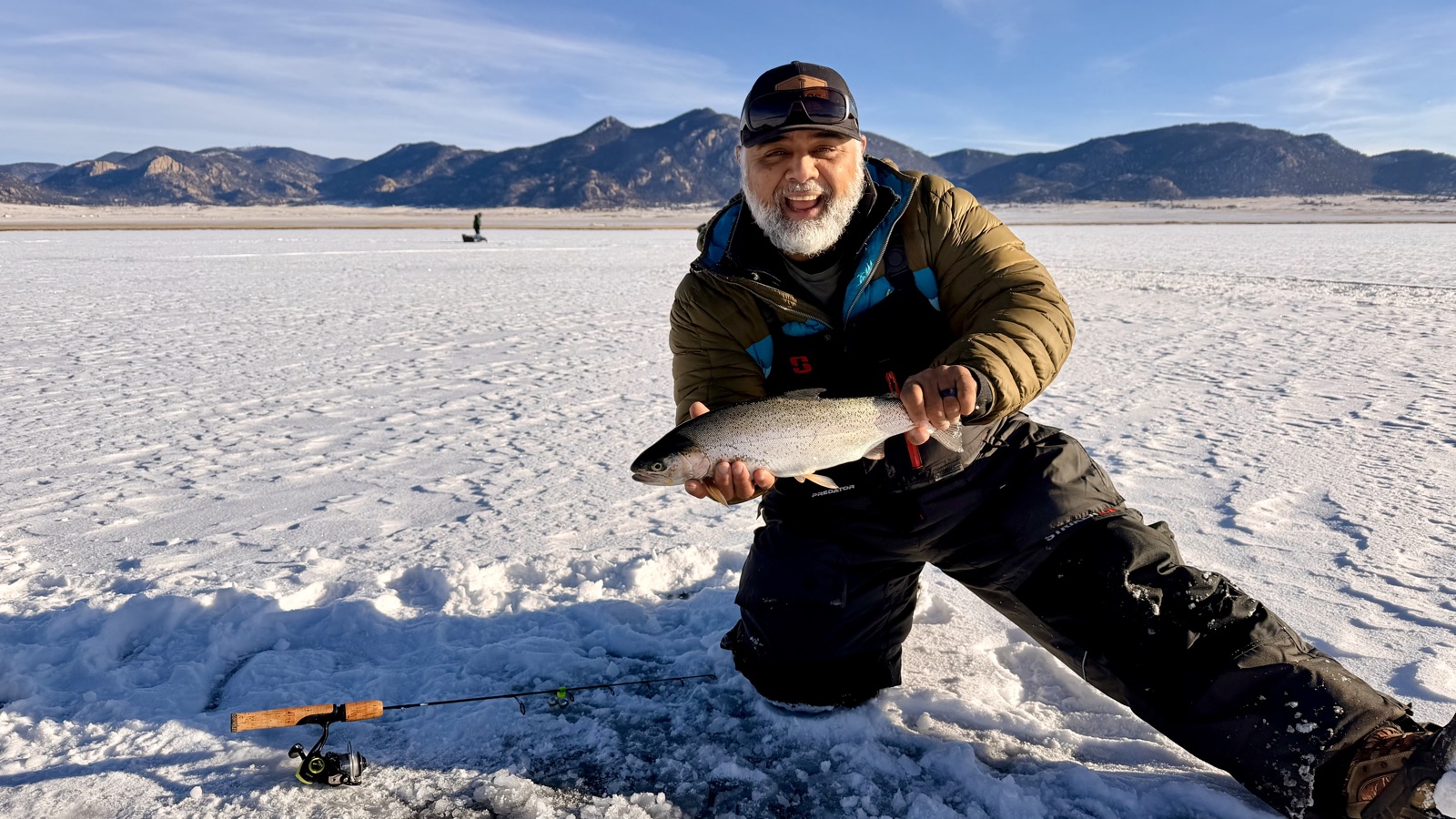
Staring at a fish finder screen in search of perch fish tacos on the hard water!! Love ice fishing for perch, my 2nd favorite type of fishing.
What do you wish someone had told you when you started guiding?
It’s not what you say, it’s how you say it to the particular client. and then MOVE! Don’t stay put on one fish, go find the fish that want to play and then come back.
Rapid Fire
- Favorite rod: Scott Radian
- Favorite reel: Lamson reels
- Coldest day you’ve ever guided: 25 degrees with some hail
- Biggest fish on your line (and where): 10 pound striper on a clouser with rattles on the San Joaquin Delta - Guide/Captain Bryce Tedford.
- Beer or coffee at the truck: Beer