
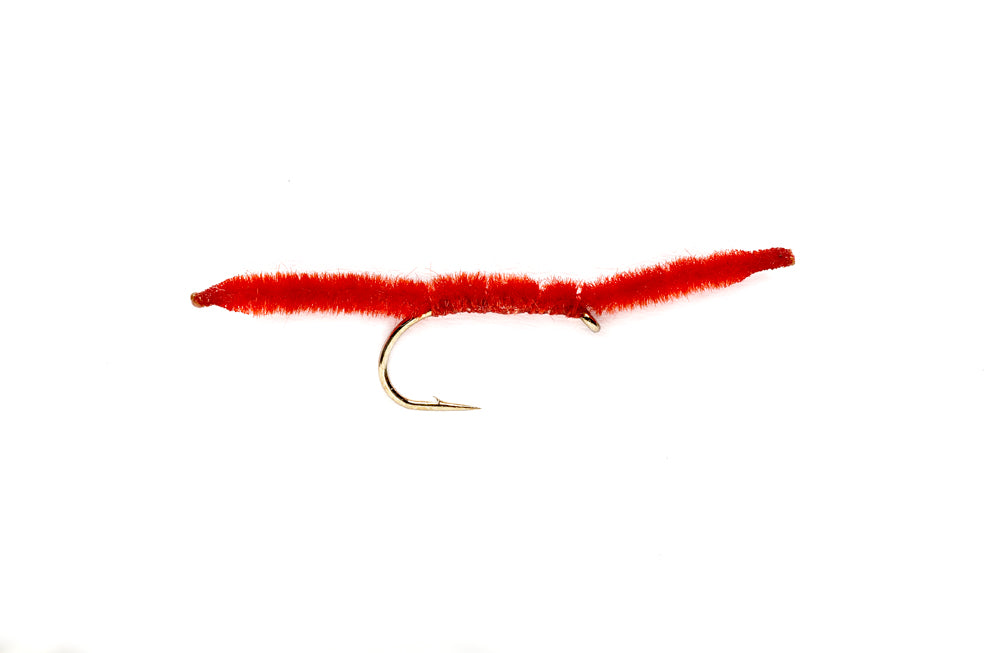
The San Juan Worm doesn’t get press. It doesn’t have a Colorado tying lineage, it isn’t elegant on the bench, and you’ll never see it in a glossy fly box photo on someone’s Instagram. It’s a piece of chenille tied to a hook. It looks exactly like what it imitates — an aquatic worm tumbling through the drift — and it catches South Platte fish on days when nothing else moves them.
I fish worms all the time. They live in the heavy nymph section of my fly box right next to the Blowtorch and the Walt’s Worm, and on post-rain afternoons at Deckers when the water is carrying any color at all, the SJW is the first fly that goes on. Ignore the bench-snobs. The worm catches fish.
The short answer
Fish the San Juan Worm as your point fly on a curved scud hook (Ultra Chenille, sizes #14–#18): default to a red #14 in high, stained, or post-rain water, drop to pink when the river clears, and save purple for overcast days and the deeper Deckers runs. Run it as the bottom-tracking anchor with a smaller midge or RS2 dropper 18–24 inches above on 5X fluorocarbon. It’s a piece of chenille on a hook — and it out-fishes prettier flies the moment the water colors up.
The Recipe
The pattern is most associated with New Mexico’s San Juan River below Navajo Dam, where it earned its name and reputation in the 1970s. From there it spread to every tailwater in the West and never left. The recipe hasn’t changed in decades because there’s nothing to improve — a piece of chenille on a curved hook does the job.
Hook: Curved scud/nymph hook — Tiemco 2457, Daiichi 1130 or 1150, Firehole 633, sizes #14, #16, #18 Bead: Optional. I tie both — bead-head for getting deep fast in higher flows, unweighted for low-flow drifts where I want it to sink slow Bead size: Slotted tungsten, 2.3mm for #14, 2.0mm for #16, 1.5mm for #18. Skip anything 2.8mm+ — that’s #12 sizing and I don’t fish #12. Thread: Uni 6/0 or Veevus 6/0, matching the body color Body: Ultra Chenille (medium) — burn the tips with a lighter to taper both ends. That’s the whole fly.
My take
The San Juan Worm is the fly people are embarrassed to admit they fish — right up until the water colors up and it’s the only thing bending a rod. I stopped being precious about it years ago. The river doesn’t award style points, and the trout have never once checked who tied what.
Three colors cover essentially everything on the South Platte:
- Red. The default. Red ranges from pure scarlet to a darker oxblood — I carry both. High water, stained water, post-rain conditions. If I had to pick one worm color for the rest of my life, it would be a #14 red.
- Pink. The clear-water variant. When the river drops and clears, red can read too bright and fish refuse. Pink — closer to a dusty rose than a bright bubblegum — is more subtle and still works.
- Purple. The wildcard. It shouldn’t work — you don’t see purple aquatic worms in nature. But on overcast days, in low light, in the deeper Deckers runs, the purple worm out-produces both red and pink for reasons I can’t fully explain. Stock a few and trust the math.
What color San Juan Worm should I use on the South Platte?
Start with red — it’s the default for high, stained, post-rain water, and if I could only carry one it’d be a #14 red. When the river drops and clears and fish refuse, switch to pink (a dustier rose, not bubblegum). Save purple for overcast days, low light, and the deeper Deckers runs.
I lean small with worms. #16 is the technical-water variant, #18 is the pressure-water variant. When fish are pressured and the standard #14 gets refused, the smaller profile slips past the refusal threshold. I keep a half-dozen #16s and at least three #18s in each color.
No #12. Some guides will tell you to fish a #10 or #12 SJW in high water. On the Platte, a worm that big telegraphs as fake even in chocolate-milk runoff. #14 is the upper limit; the small end is where the post-refusal work happens.
The Snob Problem
There’s a quiet snobbery around the San Juan Worm. “That’s not really fly fishing,” someone always mutters — usually the guy who hasn’t touched a fish in two hours while you’re unhooking your fourth. I get it; it’s a piece of yarn on a hook. No famous tyer, no clever name, no flashy hot spot to admire. But aquatic worms are real food that trout eat every single day, and imitating the real food the fish are actually eating is the entire point of the sport. The worm isn’t a loophole or a cheat code. It’s just honest. Tie it on, catch fish, and let the purists keep their dignity and their skunk.
When It Matters on the South Platte
Deckers is the home water for the SJW in my fishing. The river carries silt and stained color whenever there’s rain in the upstream watershed or a release event from the reservoir. Within an hour of a thunderstorm anywhere in the basin, the worm bite turns on. A red #14 fished as the point fly with a small midge or RS2 dropper is the rig that produces through that window. The fish are positioned to intercept dislodged worms tumbling down from the bank vegetation, and they’re not picky. There’s a specific magic to walking down to Deckers an hour after a basin thunderstorm — the water carrying that first tinge of color, nobody else willing to fish “blown out” conditions, and the trout suddenly eating a red worm like they forgot to be careful. Those windows are short and they are glorious.
Arkansas River at Pueblo has even more reliable worm fishing than Deckers because the urban runoff puts sediment in the river regularly. After any rain event in Pueblo, the red SJW catches fish aggressively for the next 24–48 hours. See the Pueblo tailwater guide for water-condition timing.
Dream Stream in spring runoff (May–June) — same playbook. The Spinney Mountain Reservoir tailwater carries sediment when the upper basin is running off. Red #14 produces.
Eleven Mile Canyon sees worms less often than the open-valley sections, but during post-rain runoff in the canyon it earns its place. Lighter purple in size #16 works for the more selective canyon fish.
How to Fish It
The San Juan Worm is a point fly. It goes on the heaviest position in the rig — the bottom-tracking anchor — and you run a smaller fly 18–24 inches above as the dropper. The combo I use most often: red #14 SJW on the point, Zebra Midge size 20 black on the dropper.
Tippet: 5X fluorocarbon to the point fly in stained water. When the water clears, switch the worm color first (pink, then purple) before you go finer on tippet — the fish aren’t refusing for tippet reasons, they’re refusing because the water cleared and the color is too loud. 5X still works on a clearing Deckers; only go to 6X if you’re seeing fish refuse a properly-colored worm with a clean drift.
Two presentation styles work:
Indicator nymphing is the standard application. Drift the worm through seams, tailouts, and bank-adjacent water where dislodged worms naturally collect. The strike often comes hard — worm-feeding fish are confident eaters, not pickers — so set on any indicator hesitation.
Under split shot, no indicator in higher flows. When the water is over 250 cfs at Deckers and the fish are pushed into deeper troughs, I’ll fish the worm tight-line style with a piece of split shot 8 inches above the fly and feel for the take through the rod tip. The grab is unmistakable.
Frequently asked questions
Is the San Juan Worm a good beginner fly? One of the best. Dead simple to tie, dead simple to fish (dead-drift it like any nymph), and it produces on exactly the stained-water days that frustrate beginners most. Start with a red #14 on the point and a small midge dropper.
Bead-head or unweighted? Both have a place. Bead-head gets the worm down fast in higher flows and deeper troughs; unweighted sinks slowly for low, clear water where you want a softer presentation. I carry both and pick by depth.
Do you really fish purple? Yes — and I can’t fully explain it. On overcast days and in the deeper Deckers runs it out-produces red and pink more often than it has any right to. Carry a few and trust the water, not the logic.
What’s the best size for pressured fish? Drop to #16 or #18. When the standard #14 gets refused on a clean drift, the smaller profile slips under the refusal threshold. No #12 — on the Platte, a worm that big reads as fake even in muddy water.
Why It Works
There’s actually a real biological argument here, not just “fish are dumb.” Aquatic worms — primarily Lumbriculidae and Naididae — live in the sediment and bank substrate of every tailwater. They get dislodged constantly when the water rises, the wind picks up, or anglers wade through the shallows. Tailwater fish eat them year-round, and during high-water events, the worm becomes one of the most-eaten food items in the river.
The pattern works because it doesn’t have to imitate something fish never see. They see real worms every day. A chenille SJW drifting past a Deckers feeding lane is recognized for what it is.
Tie a dozen in red, half a dozen in pink, half a dozen in purple. Carry them. Use them. The South Platte will pay you back.
You can pick up a quality production version through The Fly Fishing Place — use code RDC at checkout. They carry the SJW in all three colors and the sizes you’ll want.