
Here’s a fact that stopped me cold the first time I really dug into bamboo rods: almost every cane fly rod ever built — the affordable import you can order today, the $3,000 heirloom, the vintage Payne sleeping in a collector’s tube — comes from one species of bamboo grown in essentially one small corner of China. Not “mostly.” Pretty much all of it. For a material that was the backbone of the sport for over a century, the whole thing rests on a supply chain about as wide as a single river valley. I’ve put more thought into which thermos to buy.
That bamboo is Tonkin cane, and once you understand why it’s so special — and so singular — a lot of things about bamboo rods start to make sense: why they cost what they cost, why builders are so particular, and why a grass from one river in China became the soul of the sport.
Why bamboo makes a great fly rod in the first place
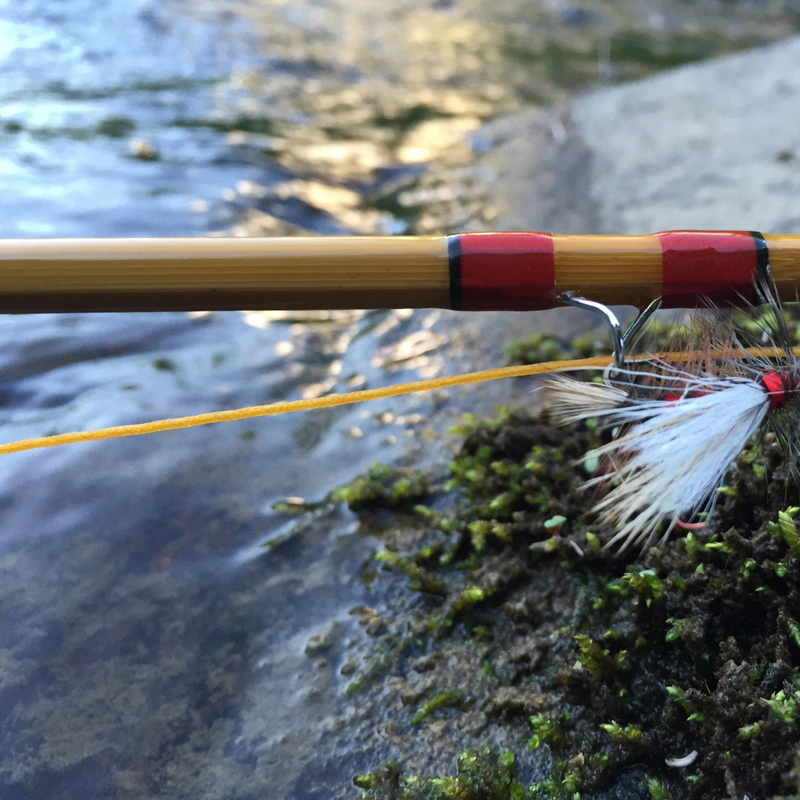
Bamboo is a grass, and its genius is where it puts its strength. Unlike a tree, which lays down fairly uniform wood, bamboo concentrates dense, lengthwise power fibers in the outer wall — right under the hard, glossy skin — and leaves the inside soft and pithy. That’s a naturally occurring high-performance composite: stiff fibers on the outside, where a bending rod takes the most stress, exactly where an engineer would put them if he were designing a blank from scratch. The plant figured out carbon-fiber layup before there were engineers around to be impressed by it.
A rodmaker just exploits what the plant already did — keeps that outer fiber layer facing out, planes away the soft inner pith, and glues the best of it back together into a hexagon. Nature did the hard part tens of millions of years ago; the builder mostly has the good sense not to argue with it. (That’s the whole trick in one sentence. The other hundred hours are in how a cane rod actually gets built.)
So why only Tonkin cane?
There are over a thousand species of bamboo, and people have tried plenty of them for rods. Only one really works for serious building: Tonkin cane. Its scientific name is Pseudosasa amabilis — though you’ll also see the older name Arundinaria amabilis, and most rodmakers just say “Tonkin.” (Amabilis means “lovely,” which is a rare case of a Latin botanical name being completely honest instead of just showing off.) Nineteenth-century rods leaned on Calcutta cane; Tonkin shoved it aside around the turn of the twentieth century, the moment builders felt the difference — the way graphite would eventually do to both of them.
Tonkin wins on a specific stack of traits:
- The densest power fibers of any usable bamboo — which is what gives a cane rod its strength, its spring-back, and its strength-for-the-weight.
- Long, straight culms with consistent walls, so a builder gets clean, full-length strips without much waste.
- Well-spaced, relatively flat nodes. Nodes are the joints in the cane, and a builder will tell you they’re the whole reason the job takes patience: at every node the long fibers break their run, the cane swells outward, and there’s a solid internal wall to cut away. Each one has to be heated, pressed flat, and filed before it’s usable. Fewer, flatter, better-spaced nodes means less of that and better rod material.
- Toughness against the insect damage and “water marks” that ruin other canes.
Try to build a precision rod out of garden-variety bamboo and you’ll end up with something that won’t hold an action or survive a decent fish — the fishing equivalent of whittling a baseball bat out of a tomato stake. Tonkin does the job, and nothing else quite does it the same way.
The one-river problem
This is the part that’s almost hard to believe. Tonkin cane grows commercially in a narrow band of hill country along the Sui River drainage in Guangdong Province, southern China — a small region, not a country’s worth of land. One commonly cited estimate puts the genuinely suitable ground at something on the order of 190 square kilometres, roughly 48,000 acres. I’ve seen that figure repeated more often than I’ve seen it sourced, so hold it loosely; the point stands either way. We’re talking about a patch of hillside, not a continent. People have tried transplanting it elsewhere, including the United States. It grows. It just doesn’t come back with the same fiber density — the exact combination of soil, latitude, humidity, and elevation in that one region appears to be the difference, and nobody’s been able to fake it anywhere else. It’s the bamboo version of those wine grapes that turn into vinegar the second you plant them one valley over.
The old image of the harvest is real and still part of the story: cane cut by hand on steep hillsides, slid down to the river, and rafted downstream in bundles to be processed and shipped halfway around the world. Which means the entire global craft of bamboo rodmaking — every maker, every price tier, the import you can afford and the heirloom you can’t — depends on the output of one Chinese river valley. Builders watch their cane supply the way I watch the flow gauge before a Deckers trip, and a “Tonkin shortage” rumor goes around the rodmaking world every few years like clockwork.
Why is it called Tonkin cane if it grows in Guangdong?
Because it’s a shipping label, not a botanical one. Tonkin is the old European name for the northern Vietnamese coast and the gulf beside it, and that’s the trade area the cane moved through on its way to Western buyers. The merchants named the material after the port it came out of rather than the hillsides it came off of, the name stuck, and a century later every rodmaker in America is still using a Vietnamese place name for a Chinese grass. Nobody has ever bothered to correct it, which is a very fly-fishing outcome — this is the sport whose most prized dry-fly feather, CDC, is French for “duck’s backside.” We are not precious about nomenclature.
It’s a small thing, but it’s worth knowing if you go digging: if you search for where “Tonkin bamboo” grows and end up reading about Vietnam, that’s why. The rod-grade cane is Chinese.
Is Tonkin cane endangered or running out?
It’s not endangered, but the supply is a real and recurring concern — because it all comes from one concentrated growing region with no backup source. Quality grading matters enormously: builders pay up for culms with the best wall thickness, straightness, and node spacing, the way I’ll happily overpay for the good tippet and then lose it in a tree on the second cast. Periodic supply or trade disruptions ripple through the whole craft. So if you ever hear that good rod-grade cane is getting scarce or pricey, now you know why — there’s simply no second valley to fall back on.
Can you grow Tonkin bamboo in the United States?
You can grow the plant — you just can’t grow rod-grade cane. Tonkin has been cultivated outside China, including in the U.S., and it survives fine as a plant. But the dense power-fiber structure that makes it work for rods doesn’t develop the same way outside that specific Sui River microclimate. The result is bamboo that looks like Tonkin and builds like a disappointment — handsome in the yard, useless on the bench. Every serious cane rod, “Made in the USA” or otherwise, still starts with culms from that one region of China.
What this means if you’re thinking about a bamboo rod
A few things fall out of all this once you understand the cane:
- The material itself is a big chunk of the cost. Before a builder ever picks up a plane, the cane has to be sourced from the other side of the planet, graded hard — culms get sorted on wall thickness, straightness and node spacing, and the good ones command a real premium — and then usually aged a year or more before it’s stable enough to build with. Rodmakers hoard seasoned cane the way a luthier hoards aged tonewood. The raw stuff is already on a slow boat before anyone makes a single shaving, and all of that sits inside the price of the finished rod. (Here’s the full breakdown of where cane money goes.)
- “Made in the USA” cane rods still start with Chinese bamboo. A rod hand-built in Montana or Idaho is American craftsmanship applied to Tonkin culms — there’s no domestic substitute, and that’s not a knock, it’s just the reality of the material. The hands can be anywhere; the grass comes from one place.
- And on the affordable end, the hands are often overseas too. Worth knowing before you shop: the value-priced cane that’s made bamboo reachable again is generally hand-planed in artisan workshops in China rather than at a bench in the Rockies. The good ones say so on their own websites. It’s real hand work on real Tonkin, and it’s a large part of why the number is what it is — but if a US-built rod matters to you, that’s the tier you’ll be paying for, and it’s a legitimate thing to care about.
- Respect the cane and it lasts generations. People are still fishing 70-year-old Tonkin rods and handing them to their kids. Nothing in my own rod quiver has ever inspired that kind of long-term planning; I buy graphite expecting to replace it, and it has never once disappointed me on that front.
My take
I came to bamboo as a lifelong graphite guy, expecting a hobby for people with more wall space than river time. Instead, the more I learned about the cane, the more the romance made sense: why the rods cost what they do, why builders are so fussy about culms, why a grass from one Chinese valley became the heart of the sport. It lands for a guy who’d rather a thing carry some history than a fresh model number every spring — same reason I’ll spend twenty minutes with a good cigar instead of three with a vape. And it makes you want to fish the thing, not hang it on a wall.
Next in the series: how a bamboo rod is actually built from that cane, and how it fishes next to graphite and glass.
Photos courtesy of Headwaters Bamboo.