
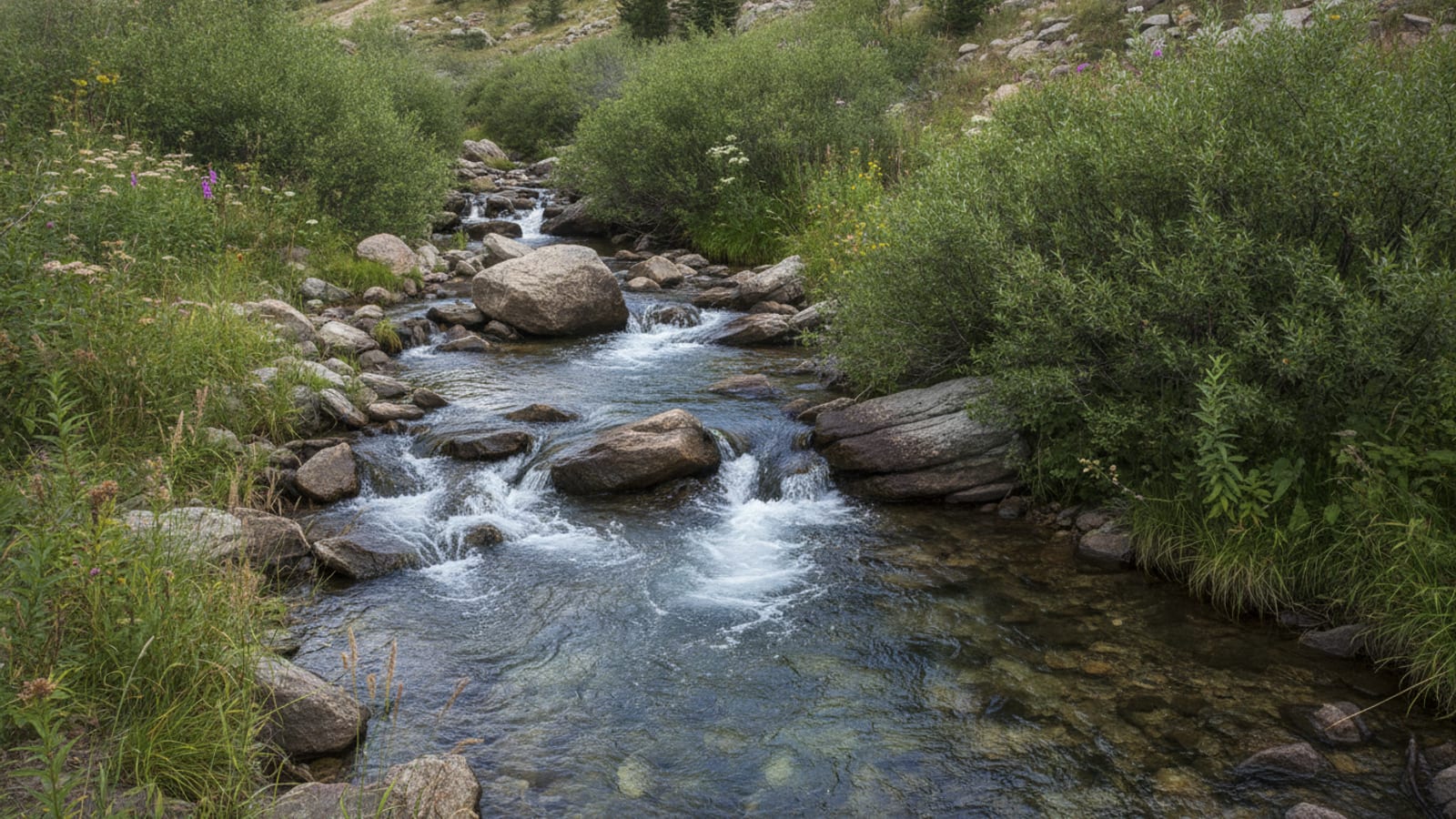
There’s a particular kind of rod snobbery that small streams cure fast. You spend years and real money chasing the perfect tailwater stick — fast, light, accurate at forty feet — and then you hike into some unnamed creek off a dirt road, make a fifteen-foot cast under a deadfall, and realize none of that matters here. On a blue line, the “best” rod is short, slow, and a little bit silly, and the trout have never once cared what’s printed above the cork.
I’ve written about why I started chasing these creeks and how to find them on a map. This is the gear companion: the rods actually worth carrying up the mountain. Eight of them, from a thirty-dollar yellow cult classic to an $825 graphite that casts like a scalpel, with the honest version of who each one is for. I fish a slow glass 3-weight up there and I’ll tell you why — but the right answer for you depends on your creeks, your wind, and how much you want to spend on a rod that catches eight-inch fish.
The short answer: tight, brushy creeks want a slow glass 3-weight under 7½ feet; open meadow water and wind want a crisp graphite 7’6” 3-weight. I fish the Scott F Series for tight water, but the best value picks are the Douglas Upstream and the Redington Butter Stick. Everything below is the why.
One promise up front: there is no wrong answer in this category that costs less than a tank of gas to be wrong about. That’s the whole charm.
The quick list
| Rod | Price | Material | Length / Wt | Best for |
|---|---|---|---|---|
| Scott F Series | $695 | E-glass | 7’2” / 3wt | Best overall — tight, brushy creeks |
| Epic 370 FastGlass | $695 | S-glass | 7’0” / 3wt | Best fast-glass — tough, fine tippet |
| Sage Dart | $825 | Graphite | 7’6” / 3wt | Open meadow water + wind |
| Douglas Upstream | $529 | Graphite | 7’6” / 3wt | Best all-rounder / traveler |
| Orvis Superfine Glass | $429 | S-glass | 7’6” / 3wt | Classic glass feel |
| Redington Butter Stick | $330 | T-glass | 7’0” / 3wt | Best glass for the money |
| Echo River Glass | $325 | S-glass | 6’9” / 3wt | Tightest brush + best warranty |
| Eagle Claw Featherlight | ~$30 | Glass | 6’6” / 5wt | Cheap thrill / first rod |
Short version: if your creeks are tight and overgrown, buy a short glass 3-weight and don’t overthink it. If they’re open meadow water or you fight wind, a crisp graphite 7’6” 3-weight is the smarter tool. Everything below is the long version.
1. Scott F Series 7’2” 3wt — best overall (tight, brushy creeks)

Material: E-glass · Length: 7’2” · Line: 3-wt · Pieces: 5 · Price: $695
This is the one I actually carry, and I’ll save you the suspense: I can’t build a rational case for spending $695 on a rod that catches small fish in small water, and I’ve stopped trying. It’s E-glass — fiberglass — with a genuinely slow action, built in Montrose, Colorado, and on a tight creek that slow action is the entire point. Under twenty feet, where small-stream casting actually lives, the F Series loads off the weight of the line alone, so you can form an accurate fifteen-foot cast that a stiff graphite rod just shrugs off. A fast rod needs line out past the tip to load. On a creek you almost never have it.
The trick Scott pulled off is the five-piece design with internal ferrules — four ferrule joints in a 7’2” rod, the spot where glass usually goes dead — and you can’t feel a single one of them through the cast. The practical payoff is that it breaks down to about eighteen inches and rides in a daypack, which matters when you’re scrambling into water nobody else bothered to hike to. I covered all of this in my full Scott F Series review, so I won’t re-litigate it here.
What earns it the top spot isn’t that it’s the best caster on this list — it isn’t. It’s that it does the one thing a blue-line rod needs to do, the close-in, brushy, drag-everything-down-to-fifteen-feet thing, better than anything else here, and it turns a wild ten-inch brown on 6X into a fight that feels twice the size of the fish. For more on why a deep-flexing blank behaves this way, see how rod action actually works.
Why I’d fish it: it’s the rod that makes me a happier angler, not a more efficient one — and on a creek, that’s the only metric that counts. Available at scottflyrod.com.
2. Epic 370 FastGlass 7’0” 3wt — best fast-action glass

Material: S2 “FastGlass” · Length: 7’0” · Line: 3-wt · Pieces: 4 · Price: $695 (Reference) / $825 (custom)
The Epic 370 is the rod for everyone who loves the idea of glass but bounces off how slow most glass feels. Built by Swift Fly Fishing out of New Zealand, it runs what Epic calls FastGlass — an S2 fiberglass blank with a quicker, livelier recovery than traditional slow glass. You still get the deep close-range load and the forgiveness that make glass so good on a creek, but it doesn’t feel sleepy when you ask it to pick up and redirect in a hurry. It’s the rod that quietly argues the whole glass-versus-graphite divide is overblown.
The other thing Epic is known for is toughness. The 370 is built to fish fine tippet with confidence on a blank that shrugs off the abuse small-creek fishing dishes out — the scrambles, the rock slips, the rod you end up using as a third hand on a steep bank. That olive blank is also just gorgeous in the hand, which never hurts. You can buy it two ways: the Reference Series built and ready to fish at $695, or a custom build at $825 if you want to spec it yourself. Either way it’s a genuine alternative to the Scott F for the premium-glass dollar — faster where the Scott is dreamier.
The honest caveats: it ships from New Zealand, so plan for a little more shipping patience than a domestic rod, and at this price you’re paying for premium glass. If pure, deep, slow-glass feel is the whole point for you, the Scott F or the much cheaper Butter Stick lean further that way. But for a tough, fine-tippet, fish-it-hard small-stream 3-weight, the 370 is hard to beat.
Why I’d fish it: glass soul with a quicker pulse — and a blank tough enough that you’ll actually fish it hard instead of babying it. Available at epicflyrods.com.
3. Sage Dart 7’6” 3wt — best for open water and wind

Material: Graphite (KonneticHD) · Length: 7’6” · Line: 3-wt · Pieces: 3 · Weight: 2⅛ oz · Price: $825
The Dart is the rod for everyone who read the Scott pitch and thought, “that sounds lovely, but my creeks are windy and half of them are open meadow.” It’s the anti-glass pick — a fast, light, high-modulus graphite 3-weight built specifically for small water, where most fast rods are built for distance. Sage tuned it for short-range loading, so it drives a tight, precise loop under a willow branch at twenty feet and then turns around and punches a hopper across a gusty park meadow without folding up.
That’s the real divide in this category, and it’s worth being honest about: glass is more fun and more forgiving up close; graphite gives you reach, line speed, and backbone when the water opens up or the wind comes over the ridge in the afternoon. On the high South Park meadow creeks, where there’s no brush to duck and plenty of breeze, the Dart is flat-out the better tool than my F Series. It’s also the most expensive rod here, and at $825 you’re paying for the lightest, crispest small-stream blank Sage makes. Whether that’s worth roughly $500 over the Butter Stick depends entirely on how many days a year you’ll fish it.
Why I’d fish it: when the creek runs open and the wind won’t quit, delicate-and-slow becomes a liability — the Dart is the small-stream rod that still works on a bad-weather day. Available at sageflyfish.com.
4. Douglas Upstream 7’6” 3wt — best all-rounder
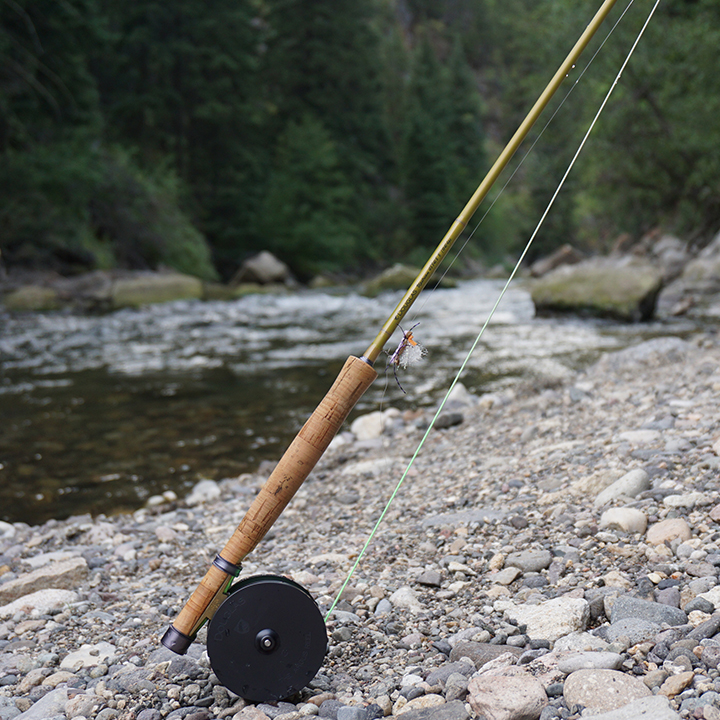
Material: Graphite (full-flex) · Length: 7’6” · Line: 3-wt · Pieces: 4 (6-piece travel option) · Weight: 1.75 oz · Price: $529
If the Scott is glass-purist and the Sage is graphite-fast, the Douglas Upstream is the rod that splits the difference and might be the smartest buy on this list. It’s graphite, but Douglas built it with a deep, full-flex action that feels far closer to cane or glass than to a modern fast rod — the cane-colored blank is even a little wink at that. The result is a rod that loads beautifully up close like glass, but recovers a touch quicker and weighs a feathery 1.75 ounces, so it doesn’t punish you when the water opens up.
Reviewers consistently put its accuracy inside thirty feet near the top of the class, and at $529 it lands well under the Sage and Scott while feeling like neither a compromise nor a budget rod. The detail that pushes it onto a lot of small-stream shortlists, though, is the travel version: Douglas makes the Upstream in a six-piece that packs down small enough to live in a carry-on or a backpack lid. If you’re the kind of angler who chases blue lines on road trips — or who wants one rod that fishes home creeks and flies to mountain ones — this is the pick. The honest trade-off: a full-flex graphite still won’t load quite as deep and dreamy as true glass in dead-calm, ultra-tight water, and at $529 it’s a real outlay for a rod this specialized — if you only fish creeks a handful of days a year, the cheaper glass below scratches the same itch.
Why I’d fish it: it’s the closest thing here to a do-it-all small-stream rod — glass feel, graphite recovery, and a travel option that goes anywhere. Available at douglasoutdoors.com.
5. Orvis Superfine Glass 7’6” 3wt — best classic glass
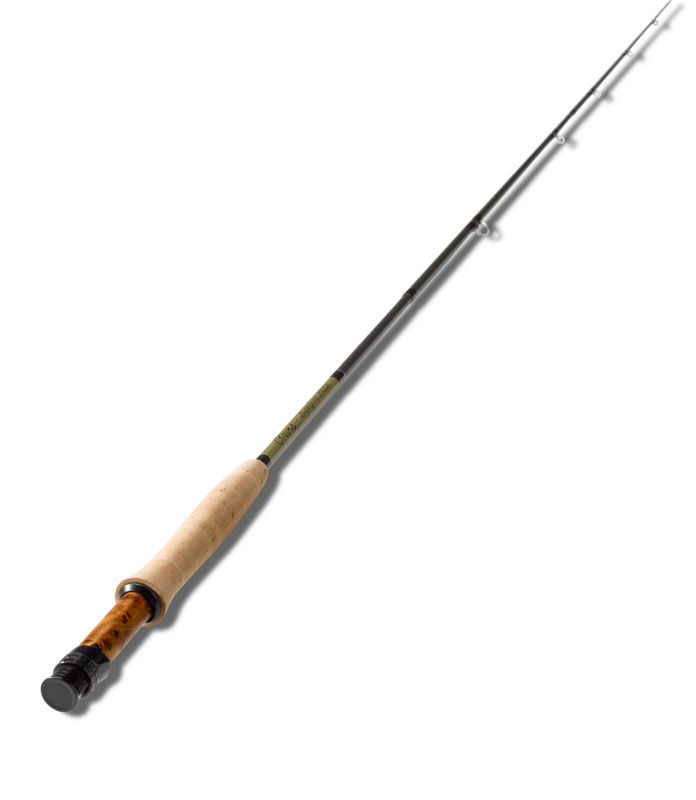
Material: S-glass · Length: 7’6” · Line: 3-wt · Pieces: 4 · Price: $429
The Superfine Glass is the rod people picture when they picture a glass small-stream rod — and at $429 it’s the most affordable way into genuinely refined fiberglass. Orvis builds it on a smooth S-glass blank with a deep, even flex and dresses it up with a burled hardwood reel seat on the 5-weight-and-down models, which makes it feel like more rod than the price suggests. It was designed with eastern spring creeks in mind, and that DNA shows: it’s happiest throwing a bigger dry on a short-to-medium cast and protecting fine tippet on the take.
At 7’6” it’s the longer end of the small-stream range, which is a deliberate trade. The extra length costs you a little in the tightest, tunnel-of-brush water, but it buys you better line control, easier mending, and more reach on the slightly bigger creeks that blur the line between “blue line” and “small river.” If your water is more open meadow stream than overgrown trickle, that length is a feature, not a bug. For the longer conversation about how glass, graphite, and cane each feel in the hand, I get into it in three rods, three feels.
Why I’d fish it: the cheapest seat at the “real glass” table, and a rod that makes a routine brook-trout afternoon feel a little ceremonial. Available at orvis.com.
6. Redington Butter Stick 7’0” 3wt — best glass for the money

Material: T-glass · Length: 7’0” · Line: 3-wt · Pieces: 4 · Price: $330
The Butter Stick is the rod I’d hand someone who says “talk me into glass but I’m not spending Scott money.” At $330 it’s a slow, sweet, honestly retro T-glass rod in a butterscotch finish that looks like it time-traveled out of 1974, and that’s entirely the point. Redington built it on a “Heritage Taper” — a deliberately old-school, deep-flexing profile — with a traditional half-wells grip and a cork reel seat. It is not trying to be a precision instrument. It’s trying to be fun, and it nails it.
At 7’0” it’s a hair shorter than the Orvis or Sage, which actually suits tighter creeks well — there’s less rod to hang up in the brush, and the slow action makes a small fish feel like an event. The honest knock is that the slow taper runs out of authority in wind and at distance faster than a graphite rod will, so if your water is open and breezy, look at the Dart or Upstream instead. But for shaded, brushy, classic small water where casts are short and the fish are eager, it’s the most rod-for-the-dollar on this entire list. It also makes a genuinely great second rod for a tailwater angler curious about glass without the buy-in. (Don’t believe the “you must spend big” reflex — I get into that in are expensive fly rods worth it.)
Why I’d fish it: maximum glass grin per dollar — the rod that proves the cheap end of this category is where most of the fun lives. Available at redington.com.
7. Echo River Glass 6’9” 3wt — best for the tightest brush
Material: S-glass · Length: 6’9” · Line: 3-wt · Pieces: 3 · Weight: 2.6 oz · Price: $325
When the creek closes in to a green tunnel — alders overhead, willows at your elbows, a roof of branches between you and any kind of backcast — every inch of rod becomes a liability, and the Echo River Glass and its stubby 6’9” length comes into its own. It’s the shortest rod on this list, and on the kind of overgrown, small water where you’re roll casting, bow-and-arrow flicking, and dapping more than you’re truly casting, short wins. Echo builds it on a modern S-glass blank with a glass-medium-fast action, so it’s a touch livelier than the slow Butter Stick — a nice middle ground if pure-slow glass feels too sleepy for you.
Two practical notes seal it. First, it’s a 3-piece, which keeps the glass feel cleaner than a 4-piece at this price, though it packs a bit longer. Second, and this matters more than people admit on rough country where rods get stepped on, slammed in tailgates, and dropped on granite: Echo backs it with a lifetime warranty and includes a hard tube. At $325 it’s priced right alongside the Butter Stick, so the choice between them is really length and feel — 6’9” and medium-fast here, 7’0” and slow there. Both are a lot of rod for the money. The honest knock: at 2.6 ounces it feels a hair heavier in hand than the premium glass here, and the stubby 6’9” length that rules in a brush tunnel gives up reach and mending the moment the creek opens up.
Why I’d fish it: when the brush turns a creek into a tunnel, the shortest rod with a real warranty is the one you’ll actually be glad you brought. Available at echoflyfishing.com.
8. Eagle Claw Featherlight — best cheap thrill

Material: Glass · Length: 6’6”–8’ · Line: 5/6-wt · Pieces: 2 · Price: ~$30
I can’t write an honest small-stream rod list and leave off the thirty-dollar yellow rod that started it for half the people reading this. The Eagle Claw Featherlight is a cult classic for one reason: it’s a genuinely fun, genuinely slow fiberglass rod that costs less than a box of flies, and it has barely changed in decades. That unmistakable banana-yellow blank, the cork grip, the single-foot “dynaglide” guides — it’s the platonic ideal of a beater rod you can throw in the truck, hand to a kid, or take somewhere you’d cry over scratching a $700 stick.
Here’s the honest caveat, because specs matter: the Featherlight comes in 5/6-weight, not in the delicate 1–4 range the rest of this list lives in. So it’s over-lined for tiny, technical 3-weight water — it won’t deliver a size-20 with finesse. Where it shines is the slightly bigger small water, the bushwhack creek where you don’t care about the rod, the kid’s first fly rod, or the “I want to try glass and I refuse to spend money to find out” experiment. Pair it with a true-to-weight line, slow your stroke way down, and it’ll out-charm rods that cost twenty times more. Buy one even if you own better. Especially if you own better.
Why I’d fish it: every serious small-stream habit should have a thirty-dollar gateway drug, and this is it. Available at eagleclaw.com.
Pros and cons, rod by rod
| Rod | Where it wins | Where it costs you |
|---|---|---|
| Scott F Series | Loads off the line alone under twenty feet; breaks down to ~18” | $695 for a rod that catches small fish — and it isn’t the best caster here |
| Epic 370 FastGlass | Glass feel with a quicker pulse; a blank you can fish hard | Ships from New Zealand; premium money for glass |
| Sage Dart | Cuts wind on open meadow water; 2⅛ oz and crisp | The most expensive rod on this list at $825 |
| Douglas Upstream | Glass-like full flex at 1.75 oz, plus a 6-piece travel version | Still won’t load as deep as true glass in dead-calm, tight water |
| Orvis Superfine Glass | Cheapest seat at the real-glass table; good line control | 7’6” gives up ground in a tunnel of brush |
| Redington Butter Stick | Most glass grin per dollar at $330 | Runs out of authority in wind and at distance |
| Echo River Glass | 6’9” rules a brush tunnel; lifetime warranty and a hard tube | 2.6 oz feels heavier in hand; gives up reach when the creek opens |
| Eagle Claw Featherlight | Genuinely fun for about $30; the beater and the kid’s first rod | 5/6-weight only — too much line for technical 3-weight water |
My take
If I could only keep one, it stays the Scott F Series — but that’s a heart pick, not a value verdict, and I’d never tell a first-time buyer to start there. For most people the smart money is the Douglas Upstream if you want one rod that does everything and travels, or the Redington Butter Stick if you just want the glass grin for cheap. The truth this whole list circles is that the gap between the $30 rod and the $825 rod is real but small, and it lives almost entirely in wind and distance — neither of which is what blue lines are about. Buy the one that makes you want to make the hike.
How do you choose a small-stream rod?
If the table didn’t decide it for you, here’s the logic underneath it. A blue-line rod is a deliberately narrow tool, and four things determine whether it fits your water.
Line weight: a 3-weight is the center of the universe. You can drop to a 1- or 2-weight for maximum delicacy and maximum giggle on tiny fish, or stretch to a 4-weight if you tangle with bigger trout or fight steady wind. But a 3 is the do-it-all small-stream line — light enough to be fun, with enough backbone to turn over a dry-dropper. I fish a 3 and rarely wish for anything else up there. (Worth noting for the record: the only 4-weight in my quiver is a bamboo rod, and I haven’t taken it up a blue line — so I can’t tell you how a 4 handles that water from experience. It’s still a perfectly sensible reader pick for windier or bigger water.)
Length: shorter for brush, longer for open water. Six-foot-six to seven-foot covers you in tight, overgrown tunnels where backcasts go to die. Seven-six gives you reach, line control, and mending on more open meadow creeks. Match the rod to your nastiest water, not your prettiest.
Material and action: this is the real fork in the road. Slow glass loads at fifteen feet, forgives bad timing, and turns small fish into a fight — but it gives up ground in wind and at distance. Crisp graphite reaches farther and cuts wind but feels dead up close. Cane is a third path entirely (I get into all three in three rods, three feels, and into the cane rabbit hole in the best bamboo rods). For classic tight creeks, slow glass. For open and windy, graphite. There’s no universal winner — only a winner for your water.
Reel and line: keep it dumb-simple. The reel is just line storage with a nice voice up here; a click-pawl like the Ross Colorado is all you need, and you can skip the sealed-drag arms race (here’s when drag actually matters). Line a slow glass rod with a true-to-weight double taper and slow your stroke down — that’s the whole recipe. Then go read up on building the rest of the blue-line kit, because the rod is the easy part.
Small-stream rod FAQ
What size fly rod is best for small streams?
A 3-weight between 6’6” and 7’6” is the sweet spot for most blue-line creeks. It’s delicate enough to fish a tiny dry and protect light tippet, but it’ll still turn over a dry-dropper rig. Go shorter and lighter for tight, tiny water; longer and heavier for open or windy water.
Is fiberglass or graphite better for blue lines?
Neither is “better” — they’re tools for different water. Glass loads at very short range and is more forgiving and more fun on small fish, which suits tight, brushy creeks. Graphite gives you reach, line speed, and wind-cutting backbone, which suits open meadow streams. Pick based on your creeks, not on internet consensus.
Do I need an expensive rod for small streams?
No — and this is the one category where I mean it. A $30 Eagle Claw or a $330 Butter Stick will catch every creek trout an $825 rod will. The premium buys refinement, lighter weight, and better performance in wind and at distance — all of which matter less the smaller your water gets.
Can I use my regular 9-foot 5-weight on a small stream?
You can, and plenty of people do — but it’s the wrong tool. A 9-foot rod fights overhanging brush, and a 5-weight won’t load at the fifteen-foot distances small creeks demand. If you fish blue lines more than a couple times a year, a short 3-weight is a genuine upgrade, not a luxury.
Next: you’ve got the rod — now build the rest of the kit and learn how to fish it. Here’s the complete blue-line setup, and when you’re ready to go hunting for new water, how I find blue lines in Colorado without anyone handing me a pin.
Some links in this article are affiliate links. We may earn a commission at no extra cost to you. Read our full disclosure.