
Let’s be honest about what a Chubby Chernobyl looks like: a craft-store accident. A block of foam, a fistful of white yarn, and four rubber legs flailing off a hook like a bug that lost a fight with a ceiling fan. On a river like the South Platte — where a trout will refuse a perfect #22 midge because your tippet caught the light wrong — you’d bet money a foam hopper the size of a Cheeto gets laughed clean off the water.
It doesn’t. That’s the whole point of this post. The Chubby is one of the few “dumb” attractors that earns a permanent spot in a technical-tailwater box, and it does it by being good at two very different jobs at once. Here’s how I fish it on the South Platte, and the sizes and colors I’ve actually come to trust.
What the Chubby Chernobyl actually is
The Chubby is the foam-and-wing evolution of the old Chernobyl Ant — the slab-of-foam attractor that came up out of the Western tailwater scene and took over big-river dry fishing in the early 2000s. Somebody looked at a fly named after a nuclear disaster and decided it needed to be bigger, which tells you most of what you need to know about the people who fish it. Where the original Chernobyl was a flat foam raft, the Chubby got a tall poly-yarn wing and a fatter, segmented foam body, which is what makes it float like a cork and show up like a flag.
The recipe is simple, which is the point — there’s no secret blend of dubbing to ruin here, no rare hackle to source. You can tie a passable Chubby on your second night at a vise and the fish won’t dock you points for the wonky one:
- Closed-cell foam body — a single 2mm strip on the small ones, doubled 3mm foam on the big ones. This is the flotation, and there’s a lot of it.
- Poly-yarn wing — usually white, sometimes pink or orange. It’s there for you, not the fish. You can track a Chubby across a glare line at forty feet, which matters more than it sounds.
- Rubber legs — the wiggle. Splayed front and back, they give the bug a little life on the water even on a dead drift.
- Flash dubbing underbody — a band of Ice Dub or similar peeking out under the foam.
Add it up and you get a fly that is nearly unsinkable, absurdly visible, and loosely suggestive of every big juicy terrestrial a trout sees in summer — hopper, beetle, cricket, adult stonefly — without committing to being any one of them. It’s the fly-tying equivalent of a vague résumé: qualified for everything, expert at nothing, and somehow it keeps getting the job.
Why does a foam attractor work on a technical tailwater?
Because on the South Platte it isn’t pretending to match a hatch. It works as a summer terrestrial along grassy banks when fish are looking up for hoppers and beetles, and the rest of the time it works as a high-floating dry-dropper anchor that suspends a small nymph and shows the take.
Here’s the thing most people get wrong: on the South Platte, the Chubby is rarely a match-the-hatch fly. It’s a confidence fly that wins two specific arguments.
One — terrestrial season is real. From about July through September, the bankside grass is full of hoppers, ants, and beetles, and the wind and the clumsiness of those bugs puts a steady trickle of them on the water. A fish that has spent all spring inspecting #22 midges will absolutely turn and crush a big foam bug that looks like 400 calories of careless grasshopper. The Chubby is my terrestrial-season searching dry — the fly I tie on to find willing fish along the banks before I commit to anything fussier.
Two — and this is the bigger one — it’s the best dry-dropper anchor I own. A Chubby will float a heavy tungsten nymph without sinking, and its poly wing is a strike indicator you’d actually choose to fish. So instead of a bobber and a nymph, I run the Chubby up top and hang a small bead-head 18–24 inches below it. The fish that won’t eat the foam still eat the Blowtorch hanging underneath, and the ones that do eat the foam are a bonus. It turns one rig into two presentations. More on the dry-dropper setup here.
My take
Eighty percent of the time I tie on a Chubby, it’s working as a dry-dropper anchor, not as the fly I expect to get eaten. Treat it as a bobber that occasionally catches fish and it’ll never disappoint you. Treat it as your main dry-fly hope on a flat at noon and it’ll break your heart.
How I fish it on the South Platte
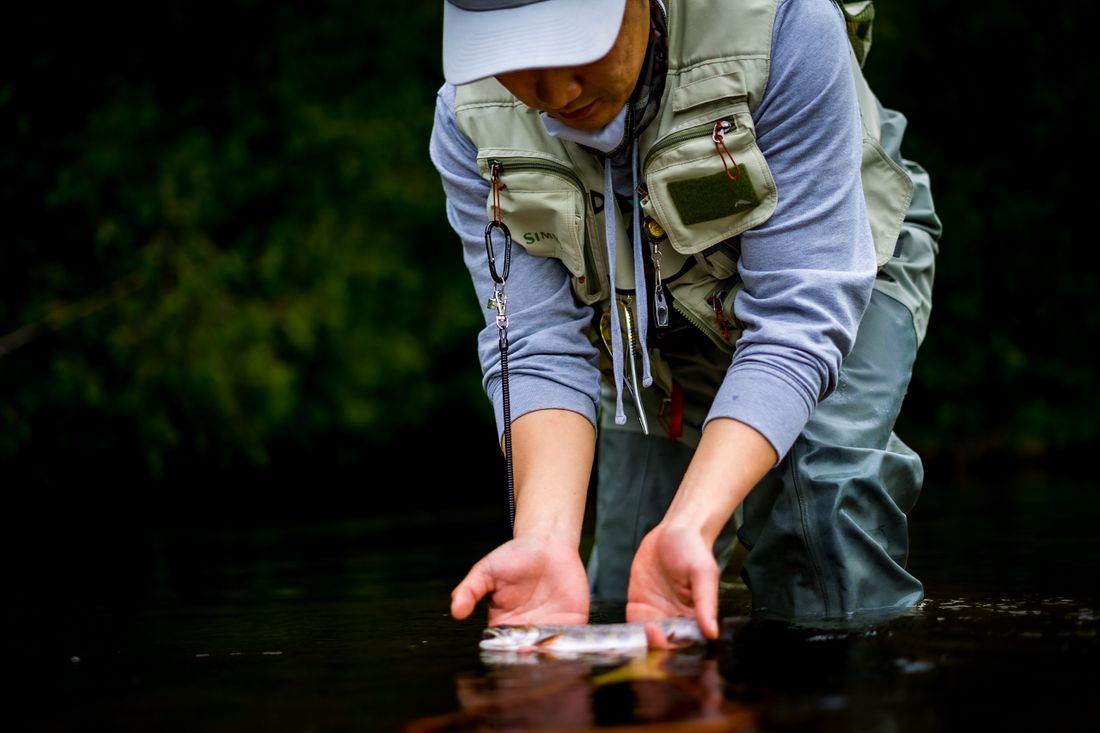
The western crowd throws Chubbies in #6 and #8 — great on the Madison, way too much bug for a pressured Colorado tailwater. Lob one of those onto the South Platte and you can practically watch the fish exchange glances. I fish #12 and #14. Smaller foam reads as a believable hopper or beetle to fish that have seen everything, still floats a dropper fine, and doesn’t slap the water like a thrown shoe on the cast.
A few things I’ve learned the hard way:
- Dead drift first, twitch second. Get a clean, drag-free float through the lane. If nothing eats and you’ve got a fish located, give it one small twitch — a foam bug that suddenly kicks is hard for an opportunistic summer fish to ignore.
- Fish the edges. Banks, the seam where fast meets slow, the foam line, the cushion in front of a boulder, undercut grass. Terrestrials get on the water at the edges, so that’s where a foam bug makes sense. Throwing it down the middle of a flat run is how you teach fish to fear it.
- Afternoons. Terrestrial fishing turns on with the day’s heat and wind — the opposite of the morning midge game. It’s a great way to fish the midday window on Deckers when the early hatch has shut off and you’d otherwise just be standing in the river feeling sorry for yourself. A foam bug and a slow afternoon get along fine.
- Grease the wing, not the body. The foam floats on its own; a little floatant in the poly wing keeps it standing up and visible. Soak the whole thing in gel and you’ll mat the wing and lose your indicator.
Sizes and colors I trust
| Use | Size | Color |
|---|---|---|
| South Platte summer searching dry | #12–14 | Tan or golden |
| Dry-dropper anchor (floats a tungsten nymph) | #12 | Tan, gold, or royal/purple |
| Off-color or low-light water | #12 | Purple or black |
| Bigger freestone / Arkansas pocket water | #8–10 | Tan, gold |
If I had to carry one, it’s a tan #12 — believable, floaty, visible, and it’ll suspend most of the droppers I fish. Purple is my “the light’s flat and nothing’s looking up” change-up; there’s something about purple foam on overcast water that fish commit to. The science there is shaky and I don’t care, because it works.
When to leave it in the box
A fly guide that only tells you when a fly works is selling you something. The Chubby is the wrong call when:
- There’s a real hatch on. If fish are keyed on PMDs or Tricos sipping in flat water, a foam bug is an insult — like bringing a beach ball to a chess match. Match the hatch and fish small.
- The water’s low, clear, and glassy and the fish are spooky. A big bug landing on a skinny flat sends a wake that empties the run. Downsize, lengthen your leader, or switch to a stealthier presentation.
- You actually want the dropper deep. The Chubby suspends a nymph in the top couple feet beautifully. If the fish are glued to the bottom of a deep run, that’s an indicator-and-split-shot job, not a dry-dropper one — see the nymph rigging guide.
Frequently asked questions
Will trout on a pressured tailwater really eat a foam hopper? In summer, yes — especially along grassy banks and on warm, windy afternoons when real terrestrials are getting blown onto the water. Keep it smaller than the western standard (#12–14 on the South Platte) and present it dead-drift on the edges, not down the middle of a flat.
Is the Chubby Chernobyl better as a dry or as a dry-dropper indicator? For Colorado tailwater fishing, mostly the latter. Its flotation and tall poly wing make it the best dry-dropper anchor I own — it floats a tungsten bead-head and shows the take like a purpose-built indicator, while still drawing the occasional eat on top.
What’s the most versatile single Chubby to carry? A tan #12. It reads as a believable hopper or beetle, floats a dropper, and stays visible in riffled light. Add a purple one for flat, overcast days.
Bottom line
The Chubby Chernobyl is proof that “technical water” doesn’t mean every fly has to be tiny and serious. Tie on a tan #12, hang a Blowtorch off the back, and walk the banks on a hot July afternoon — you’re fishing two flies at once, watching a wing you can actually see, and giving summer fish a shot at the big, dumb meal they’re secretly hoping for. It has no business working on the South Platte. It works anyway.
You can stock Chubbies, foam, and the rest of the terrestrial box through The Fly Fishing Place — use code RDC at checkout. The rest of my summer dries live in the fly box I carry.