
In this guide
Part 6 of The Tight Line — my series on fishing a tight-line rig on South Platte tailwaters. Start with Part 1.
Here’s how a good brown gets lost at Deckers, usually to a habit the angler doesn’t know he has. The sighter stalls, you feel weight, and you do what every trout fisherman is trained to do — lift hard, straight up, like you’re setting on a bluegill. The fly comes back with a curl in the 6X where the knot used to be, and you’re left holding a rod with no fly on it, doing the math on an old reflex that just cost you the best fish of the morning.
That vertical “trout set” works fine on a fly line, where stretch and a soft tip absorb the shock. On a tight line you’ve got none of that cushion — the leader is a nearly straight pipe from rod tip to tungsten jig, and a vertical yank lands all that force on one point: the knot, or the hook hold in soft tissue. Something gives. Usually the 6X. The fix isn’t a harder or faster set — it’s a different direction, and most anglers learn it the expensive way, one curled-back tippet at a time. Here’s the version worth having before you leave the truck.
Why the vertical trout-set fails on a tight line
Detecting the take is the read; the hookset is what you do with it — and the moment you have to act, the tight line turns into a liability if you set wrong.
Look at what’s between you and the fish on a mono rig: a long mono butt, a sighter, a tippet ring, then 5–6X fluoro down to the fly. No fly line, no belly of stretchy coated line soaking up the strike. That directness is why you feel the tick — but it also means a set transmits instantly and fully. Worse, fluorocarbon stretches far less than the nylon mono of a dry-fly leader (which gives 20–30% and forgives a hard strike). Combine a low-stretch tippet, a near-zero-slack rig, and a vertical yank, and you’ve built the perfect machine for snapping thread. It takes less than you’d believe: the set that snaps 6X is usually one the angler would have called “firm.” On the light 5–7X you fish for a drag-free drift, firm is the problem — and respecting that is the one part nobody’s instincts cooperate with.
The low downstream sweep — the set that actually works
Here’s the move. When the sighter tells you a fish ate, sweep the rod low and downstream, toward the near bank — not up. The tip drops toward the water and pulls across, drawing the hook back into the corner of the mouth instead of ripping it upward out of soft tissue. Three things make this work where the vertical set fails:
- It drives the jig hook into the hard corner. Most tight-line flies ride on a jig hook — a Blowtorch or a Perdigon on the point, a small mayfly nymph on the dropper — and a jig on a slotted tungsten bead rides point-up. A downstream sweep pulls that upturned point into the scissors at the corner of the jaw, the best-holding bone in a trout’s mouth, instead of the soft roof where it tears free the instant the fish head-shakes.
- It loads the rod instead of shocking the knot. Sweeping low bends the long rod through its length, and that flex is your shock absorber — you’re bending a 10-foot lever, not snapping a string. The soft tip that lets you feel a #20 tick is the same tip that saves your 6X, but only if you let it bend.
- It uses the current and keeps the fish down. A fish pointed into the flow stays pinned; one set straight up gets a half-second of slack as it drops back, and that’s when hooks fall out. The low rod also keeps the fish under — most trout that come off do it on the first panicked jump, and a sideways pull smothers that jump before it starts.
Set fast, too, on any hesitation or stall, anywhere in the drift, the end and the swing up included. Once the rig is below you, keep the sweep low and toward the bank so it pulls the hook into the corner rather than out the front. On a long rod like my Diamondback 10’7” 3-weight the whole thing should look almost lazy — a smooth pull low to the side, not a strike. Done right, someone watching from the bank might not even register a set; it looks like the rod leaned over and a fish happened to be attached. That’s the goal — if your set looks dramatic, it’s costing you fish.
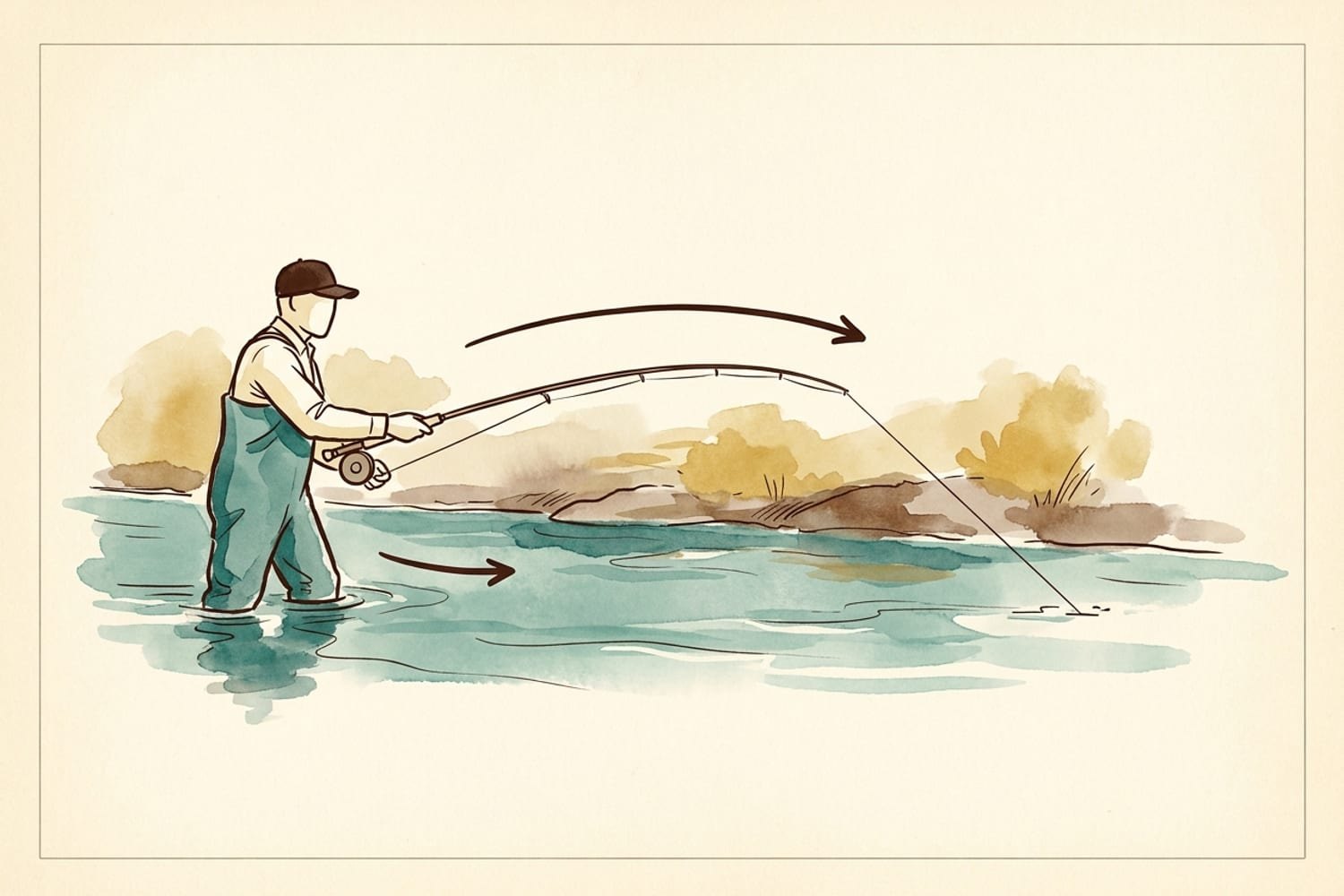
How far and how hard — the ten-inch set
If “low and downstream” is the direction, “short and sharp” is the dose. The mistake people make once they buy into the sweep is to make it big — a long, full-arm haul that keeps accelerating toward the number that pops your knot, especially with a heavy bug or a hot fish on the line. The fix the best tight-line anglers preach is the same one: a good set is short and sharp, roughly ten inches of travel, fast but strictly limited in distance. Snap the point into the corner and stop. The classic overcorrection: told to quit setting upward, anglers start setting sideways and enormous, keep breaking off, and blame the tippet. The tippet is usually fine. The set is a foot too long.
Timing — instant but smooth, never a yank
Speed and violence are two different things, and a tight-line set needs one without the other.
Instant, because trout on a pressured tailwater eat and reject a nymph in well under a second. There’s no “let him take it” — the moment the sighter does something the drift doesn’t explain, you’re moving. This is the opposite of the dry-fly clock, where the old governor is to mutter “God save the Queen” before you lift so you don’t pull the fly off a sipping fish’s nose. On a tight line there is no Queen: you set on the symptom, the stall or tick, and sort out whether it was a fish afterward. Which means setting on nothing, constantly, and feeling foolish doing it. The most-quoted number in nymphing is that a third of takes go un-set because the angler assumed the pause was bottom — and plenty of anglers live on the wrong side of that stat for years, thinking “rock, rock, rock” while fish sample their flies and spit them. Set on five rocks rather than hand back the one brown that was eating.
Smooth, because a yank breaks tippet and tears hooks. The difference is how you start the motion: a yank begins with a jerk that spikes tension before the rod can load, while a sweep begins with acceleration — you start the rod moving and let it build, so by the time the line comes tight the rod is already bending and absorbing. The cue worth saying out loud, like a lunatic talking to a river: react fast, pull slow. Mumble it on the first few drifts of a session, because the trout-set ghost never fully leaves — it just gets quieter.
What over-setting actually does
When someone’s leaving fish on a tight line, it’s almost always over-setting, and it shows up two ways. Most tight-line anglers have donated fish to both.
Break-offs. Too much force, too vertical, and the tippet parts at the tippet-ring or fly knot. You feel the fish for a split second, then nothing, and your rig comes back short a fly — there’s a sinking quality to that tick-then-slack every euro angler learns to dread. The fix is the sweep: lower angle, shorter pull, let the rod load.
Pop-offs. The sneakier one. You set hard enough to pull the hook through a barely-buttoned fish, or tear a marginal hold. It flashes, head-shakes, and it’s gone. It feels like bad luck — “it just came off” — when really you ripped the fly out before the point found the corner. A lot of what gets blamed as “short strikes” at Deckers is really long-setting.
There’s a quieter cost that compounds, too. Every empty over-set rockets your rig out of the water and back over the run, and on a glassy tailwater flat that commotion puts down every fish in the slot — the ones you were going to catch next. A missed set should be a non-event, not a tantrum.
What changes from river to river — and at different flows
The direction and the dose stay the same everywhere, but how much margin you’ve got changes with the water, and the South Platte hands you a few different classrooms within an hour of my place in Colorado Springs. Deckers, my home water, is forgiving — structure and a little chop in the faster runs hide a multitude of sins, so a slightly-too-long sweep costs you less; it’s where I’d send someone to drill the ten-inch set until it’s muscle memory. Cheesman Canyon is the opposite: educated fish, low clear water over slick granite, where a botched set that lines the run shuts the whole slot down for an hour, so the short in “short and sharp” matters most. The Dream Stream is slower and glassier, bigger fish in skinny water — same low sweep, but a rig rocketed off the flat on a miss is the loudest thing for fifty feet, so keep your sets there almost apologetically small.
Flow rewrites the page on top of all that. High water does more of your work — a fish hooked low gets pinned downstream, and the broken surface buys back the margin a botched set would cost, so you can lean on a firmer hand. In low, clear water that protection evaporates: spookier fish, subtler takes, no chop to hide behind. Same move, half the volume. The rule that carries between them: match your set’s loudness to the water’s forgiveness.
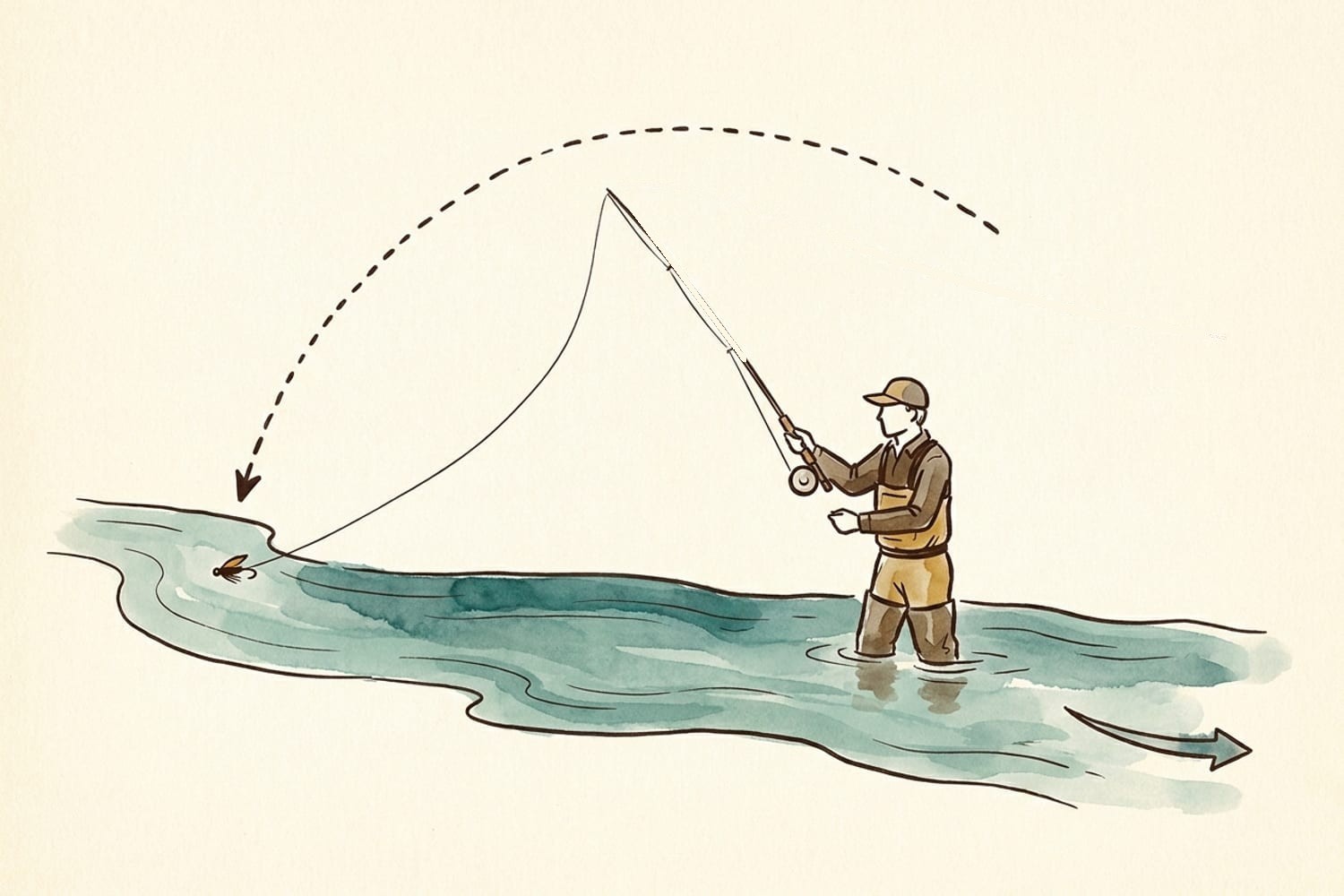
Recovering after a miss without blowing up the run
You will miss — on rocks, on phantom ticks, on real eats you were a hair too slow for. The skill isn’t never missing; it’s missing quietly so you get another shot at that fish and the three others sharing the seam.
When a sweep comes up empty, don’t rip the rig out and false-cast it back — that spooks the run. Let the low sweep flow into a soft lift, lob the rig back to the top of the same drift line, and re-fish the slot. Because the sweep stays low, your flies are already in position to continue, no false cast over the fish’s head. Think of the set and the recovery as one motion with a pause in the middle; that’s how the second and third fish come out of a seam that would otherwise blow up on the first miss. And don’t quit early — plenty of surprise fish come on a fast set at the very end of the drift, as the flies swing up like an emerging insect and a trout that tracked them all the way down finally commits.
Two habits make re-drifts pay off. Set, then re-present — treat a missed set as the start of the next drift, not a failure; a trout that nipped and missed often comes back if the fly reappears naturally, but only if you didn’t line the pool (the quiet recovery and leading the flies into the next drift are the same idea: stay in touch, stay subtle). And keep your feet still — re-drift the same lane from the same spot a few times before you move, because most missed eats are right where the first one happened, and “just repositioning a little” is how you end up watching the fish streak off ahead of your boots.
This is why the sweep protects more than your tippet. It protects your next ten casts.
Telling a foul-hooked fish from a clean eat
Sometimes you sweep and come tight to a fish that fights all wrong — heavy, dogged, planing sideways with weight you can’t explain for the size. That’s often a foul-hooked fish: you set into a trout that drifted into your tippet, not one that ate. A clean eat head-shakes — hooked in the corner of the jaw, the fish runs and fights from the front end, and you feel the throb telegraphed up the tight line. A foul-hooked fish planes and dredges — hooked in the body or a fin, it turns broadside and leans its whole flank against the flow, dead weight that surges sideways with no head-shake rhythm.
Knowing the difference keeps you from horsing a sideways-planing fish on light tippet thinking it’s the brown of the season. It’s an easy mistake: a dredging weight feels like a giant, you lean on the 6X, and the brief ugly flash before the break-off shows a very average rainbow hooked in the dorsal. A fish hooked in the back fights like it’s twice its size, which is the only advantage it has at that point. A rash of them is a symptom worth reading, too — usually you’re setting a beat too hard on every twitch, or your point-and-dropper rig is deep enough that the trailing dropper snags fish on an aggressive lift. Either way it’s the same note as a break-off — too much set — so dial it back.
My take
The hookset runs backward from everything instinct says. A lifetime of trout-setting straight up gets punished on a mono rig every time: break-offs on the good fish, pop-offs on the maybes, a spooked run after every clean miss. Sweep low and downstream instead, keep it to about ten inches, and let the long rod load and the current help. I’d drill it at Deckers until it’s boring before taking it to the Dream Stream, where one sloppy set costs you the whole flat. React fast, pull slow, sweep low.
Does the sweep direction change if the fish takes directly upstream of me?
It shifts, but the principle holds: you still want a low, sideways set that pulls the hook into the corner of the jaw rather than straight out. If a fish eats directly up and across from you, sweep low to the bank on your downstream side so the hook draws back toward the corner and the current helps turn the fish — a straight-back-at-you pull tends to slide the hook out the front. The one set to retire is the vertical lift; everywhere a fish eats on a tailwater, some version of “low and to the side, toward the flow” beats “up.” Read the angle of your sighter (which I broke down in reading the sighter) and sweep away from where the fish’s head is pointing, not over the top of it.
What if the sighter goes suddenly slack instead of stalling?
Treat slack as an eat until proven otherwise — it’s the take people miss most, because it’s the opposite of what they’re watching for. We’re trained to react to the sighter stalling, but a fish that eats and turns toward you, or lifts slightly with the fly, takes the tension out of the rig — the sighter goes limp, sags, or jumps upstream for no reason the current explains. Same response: set low and to the side, gathering that slack as you go so the rod comes tight in one motion. The trap is the slack tempts a big yank to “catch up,” and the instant it does come tight you’re right back to popping 6X. A slackening sighter on a dead drift is almost never the river being polite; it’s usually a fish that already has your fly.
Bottom line
The tight-line hookset isn’t a harder trout-set — it’s a different move. Sweep the rod low and downstream toward the bank instead of lifting vertically, and you do four good things at once: drive the jig into the hard corner of the jaw, load the long rod so it absorbs the shock instead of the knot, let the current pin the fish, and keep your rig low and ready to re-drift if you miss. React instantly, pull smoothly, keep it short, never yank. Over-set and you’ll break off the good ones and pop the maybes; sweep right and you’ll land more fish on lighter tippet than you thought the river would allow. Once the fish is buttoned, the next problem is bringing it to hand on thread-thin fluoro — its own skill, and one most anglers learn the hard way.
Next in The Tight Line → Part 7: Tight-Lining Pocket Water vs. Flats — the hookset stays the same, but the water in front of you changes how you set up for it.
Hooked up and worried about the tippet? Part 8 covers landing trout on light tippet — and if you want the leader and tippet logic behind all of this, start with leaders and tippet for tailwater trout.