
It’s January in Colorado Springs, dark by five, single digits outside, and I’m at the vise because the rivers can wait until the wind quits. The bench in front of me holds maybe a dozen things. That’s it. And I’ll out-tie my buddy with the four-drawer cabinet all winter.
Productivity at the vise has almost nothing to do with how much material you own. It’s how much of what you own you actually use.
That buddy has several thousand dollars of materials — labeled, organized, beautiful — and produces fewer good flies than I do, because he spends the first twenty minutes of every session excavating a hook he knows is in there somewhere. A materials hoard isn’t a tying operation. It’s a craft-store landslide with a vise in the middle. I went through that phase. The drawers are in my basement, and we don’t talk about the drawers.
What I keep now is the working set: the stuff I burn through every winter, the materials that show up in most of the patterns in my South Platte box. Here’s what’s on the shelf, by brand, and why each one earned the spot — plus, at the end, the stuff that quietly got cut.
The short answer — my working tying kit
My whole bench is about a dozen things: Semperfli Nano Silk thread (18/0/30D, 12/0/50D, and 70D), Hanak and Fulling Mill jig and nymph hooks in #16–#20, MFC slotted tungsten beads, UTC wire in small and extra-small, MFC dubbing, Fulling Mill CDC, the best hackle I can get, and UV Crafts plus Solarez resin. Spend up on the two things you touch on every fly — thread and hooks — and stay minimal on everything else. Everything below is why each one earned its spot, plus the stuff that quietly got cut.
At a glance — the working materials inventory
| Category | What I stock | Brand |
|---|---|---|
| Thread | 70D, 12/0 (50D), 18/0 (30D) — gel-spun | Semperfli |
| Hooks | Jig and nymph hooks, #16–#20 | Hanak + Fulling Mill |
| Beads | Slotted tungsten, multiple sizes | MFC |
| Wire ribbing | Small + extra-small, copper/silver/gold | UTC |
| Dubbing | Natural and synthetic, the colors I cycle through | MFC |
| CDC | Natural + dyed, for emergers and soft hackles | Fulling Mill |
| Hackle | Grizzly, brown, dun — best quality I can get | Best available |
| UV resin | Ultra-thin for bodies, color for hot spots | UV Crafts + Solarez |
| Foam, streamer materials | Marabou, schlappen, foam strips | Whatever the shop has |
Thread — Semperfli
Thread is the one material you touch on every single fly, which makes it a strange place to cheap out — and exactly where most beginners do. I run Semperfli, mostly their Nano Silk gel-spun line, and I keep three weights on the bench:
- 18/0 (30 denier) for the smallest stuff — midges and tiny emergers. It’s absurdly fine, builds almost no bulk, and is far stronger than it has any right to be. This is the thread that keeps a #20–#22 head from looking like a thumb.
- 12/0 (50 denier) as the everyday fine thread — the middle ground that most of my nymphs and dries get tied on. Effectively unbreakable for its diameter.
- 70 denier for the heavier work — bigger nymphs, jig bodies, anywhere I want a little more thread to build a body or anchor materials in a hurry.
Quick note on those numbers, because they trip people up: gel-spun threads like Nano Silk don’t map onto the old aught-to-denier scale the way polyester does. Semperfli labels its own spools 18/0 = 30D and 12/0 = 50D, and that’s the sizing I’m quoting here — a GSP thread is far stronger and finer than a polyester thread of the same denier, which is exactly why the numbers look “off” if you’re used to standard thread.
Gel-spun thread is the upgrade most tyers skip and shouldn’t. It’s dramatically stronger than standard thread at the same diameter, which means you can crank down hard without snapping and still keep heads tiny on small flies. The first time you tie with good gel-spun after years of bargain thread, it feels like someone fixed your hands.
What to avoid: the mystery thread that comes in starter kits. It frays, it snaps at the worst possible moment — always two wraps from done — and it teaches you to tie timidly because you don’t trust it. A few dollars of Semperfli makes the entire problem evaporate.
My take: Nano Silk 12/0 lives in the bobbin most of the time. The 18/0 comes out for the tiny stuff, the 70 for anything beefy. Three spools cover 90% of a Colorado bench.
Hooks — Hanak and Fulling Mill
Hooks are where small choices compound across hundreds of flies. The wrong hook makes the right pattern look amateur no matter how clean your tie is. I run two European brands: Hanak and Fulling Mill.
Both are sharp out of the box — properly sharp, not “fine until it bounces off a trout’s jaw” sharp — both run consistent in size across the box, and both hold up to fish without straightening. The jig hooks are where these two really shine, and jig nymphs (Blowtorch, Perdigon, Duracell) are the backbone of my box. A consistent jig hook under a tungsten bead is the literal foundation of a clean competition-style nymph — get it wrong and everything stacked on top sits crooked.
For the South Platte, #16 to #20 covers the vast majority of my nymphs. I tie small — down to #20 on a lot of patterns — so the small end of that range matters to me far more than the big end. Your water might pull you the other way, which is exactly why I don’t tell people to buy hooks by the gross before they know what they fish. I bought 500 of one size years ago because they were on sale. I have tied maybe forty. The other 460 are aging gracefully in a drawer, a monument to my discipline.
What to avoid: buying hooks in bulk before you know which patterns you tie most. Start with the sizes you fish, work through them, and commit to bulk only where you burn through fastest.
My take: Hanak and Fulling Mill are the two I trust without thinking. The jig hooks are the reason.
Beads — MFC slotted tungsten
Beads add the weight and, on a lot of patterns, the visual trigger. The wrong bead on a great pattern gives you a fly that sinks wrong or just looks slightly off in a way you can’t unsee.
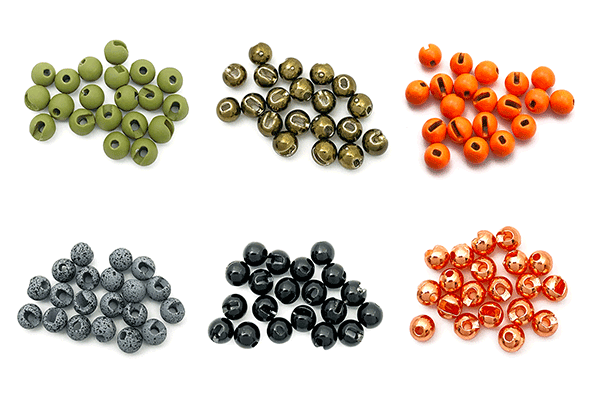
I use MFC slotted tungsten almost exclusively. Slotted fits jig hooks. Tungsten is dense, so a smaller bead gets the same sink rate as a bigger brass one — which matters enormously when you’re tying small and don’t want a clunky head riding a #18. I keep a range of sizes to match my hooks, in gold, silver, black, and copper, and that’s genuinely all the colors I need.
When you’re tying fifty of the same nymph in a winter session, bead consistency — size and weight matching across the whole batch — matters far more than it does when you’re tying five for the weekend. A batch where every bead seats the same is a batch that fishes the same. MFC runs consistent enough that I’ve stopped checking. I used to sort beads with calipers like a man with too much winter on his hands. I was, in fact, exactly that man.
My take: tungsten only, slotted only. Match the bead to the hook and stock only the sizes you actually fish. The 200-bead variety pack is a trap.
Wire ribbing — UTC
Counter-ribbing protects thread bodies from teeth and adds the segmentation that triggers strikes. Just about every nymph I tie wears a wire rib, so it’s a material I go through quietly and constantly.
I use UTC wire in small and extra-small. Copper is the universal — it works over every body color and never looks wrong. Silver for clear-water patterns and contrast, gold for warm-color flies. UTC runs uniform in diameter and, crucially, doesn’t kink when you wrap it, which is the entire game with wire. Kinked wire is just a tiny spring waiting to ruin a body you spent two minutes on. Ask me how I know. Actually don’t — the body was for a fly I was tying to show off, which is the universe’s favorite moment to hand you a kink.
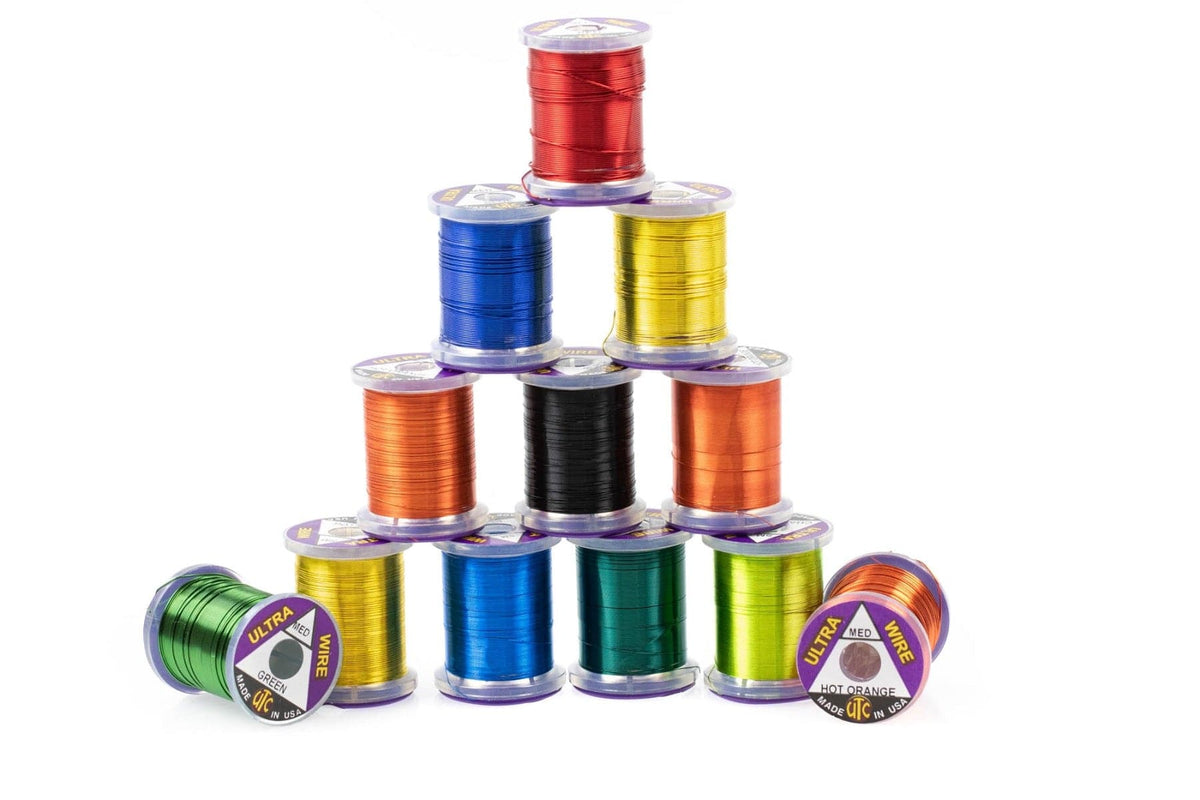
My take: one spool each of copper and silver in small and extra-small covers most nymphs. Add gold when a pattern asks.
Dubbing — MFC
The dubbing aisle is where good intentions go to become clutter. The options are nearly endless and almost all of them are tempting. I keep it boring on purpose and run MFC dubbing in the colors I actually cycle through — natural tones for buggy nymph bodies, the flash colors for Perdigons and midges. Between the natural and synthetic blends, it covers the bodies on most of what I tie.
Skip the specialty dubbings until you’ve burned through the basics. They earn space by being usable across many patterns, not by being the prettiest jar on the shelf. (They are, however, always the prettiest jar on the shelf. That’s how they get you.)
CDC — Fulling Mill
CDC is the buoyant little feather from around a duck’s preen gland — water-shedding, breathing, softer than anything synthetic. It’s required for emergers, soft hackles, and any pattern where natural movement is the whole point.
I use Fulling Mill CDC. Natural is the default; I keep dyed olive, dun, and brown on hand for BWO, PMD, and caddis emergers. CDC quality varies a lot between sources, and it’s not always obvious until you’re at the vise wondering why your emerger looks like it lost a fight. I’ve bought the cheap puffs. They tie up sparse and sad, and a sparse, sad emerger is a thing trout somehow notice from three feet down. Fulling Mill’s runs consistent in fiber length and color, which is the difference between a passable emerger and one that actually rides right.
My take: don’t skimp on CDC. It’s the one material where cheap visibly shows up in the finished fly.
Hackle — best available
Hackle is the most expensive thing on the bench and the one place I just buy the best quality I can get my hands on, brand be damned. A premium saddle or cape costs real money up front, but it produces hundreds of dry flies, so it’s a one-time spend that lasts seasons. Spread across the flies it makes, good hackle is cheaper than bad hackle.
I keep three colors: grizzly (Parachute Adams, Elk Hair Caddis), brown (PMDs, attractor dries), and dun (Sparkle Duns, BWO patterns). If you don’t tie dries, you can skip hackle entirely and feel no guilt. If you do, this is where the budget goes — buy quality once.
What to avoid: kit hackle. The barb stiffness and color uniformity are too variable to trust, and you’ll fight it on every fly. Buy one good cape and you’ll know exactly what you’re getting every time you pull a feather.
UV resin — UV Crafts and Solarez
UV resin replaced head cement on my bench for nearly everything that used to need it. Two bottles do the work:
UV Crafts ultra-thin for Perdigon bodies and thread overlays — hard, clear, cures without adding bulk. It flows into the thread wraps and seals them glass-smooth, which is exactly what a Perdigon body wants.
Solarez color resin for hot spots and flash — a small touch over a bead or on a tag that stays vivid through the cure and the season.
A UV torch cures both in seconds. (More on the torch and the rest of the tools in the bench tour.)
My take
UV resin is the upgrade that takes nymph bodies from “good” to “competition-clean.” It’s also the upgrade that gets resin on your fingers forever. Worth it.
Foam and streamer materials — whatever the shop has
This is where I stop being brand-loyal entirely. For foam strips (terrestrials, Chubby Chernobyls, attractor dries) and streamer materials (marabou for Wooly Bugger tails, schlappen for collars), I buy whatever the shop has in the color and size I need. These just aren’t materials where the brand changes the fly — foam is foam, marabou is marabou, and a trout has never once inspected the label. Buy the color, tie the fly, move on.
What to avoid: the 50-pack assortment of anything. A few foam colors and the marabou and schlappen for the streamers you actually fish. Don’t buy variety you haven’t earned.
The stuff that doesn’t earn space
A working bench is defined as much by what’s not on it. Here’s what I’ve stopped buying:
- Exotic naturals — jungle cock, fancy pheasant, the heritage feathers. Gorgeous, traditional, and almost never in a fly I fish on a Colorado tailwater. They live in someone else’s drawer now.
- Single-pattern materials — anything I’d buy for exactly one fly I tie twice a year. If a pattern needs a material that does nothing else, I usually just buy that pattern instead of stocking a lifetime supply of a thing for two flies.
- Color completism — I don’t need every shade of dubbing or every bead finish. Five colors that match real bugs beat fifteen that match a catalog.
- Beginner-kit everything — the all-in-one kits are a fine way to find out you like tying, and a bad way to stock a bench you’ll keep. The thread breaks, the hooks are soft, the hackle’s a mystery. Outgrow it fast.
None of that is snobbery — it’s shelf space. Every jar that doesn’t get used is a jar in front of the one that does.
The order to build a materials kit
Starting from zero, this is the buy order that gets you tying productively fastest:
- Thread (Semperfli Nano Silk 12/0 black, then add 18/0 and a 70 denier)
- Hooks (Hanak or Fulling Mill jig hooks in your most-fished sizes)
- Tungsten beads (MFC slotted, the sizes that match your hooks)
- UTC wire (copper + silver, small and extra-small)
- MFC dubbing (a few core colors, not the rainbow)
- Hackle (best grizzly you can get, if you tie dries)
- UV Crafts resin + a UV torch (when you’re ready for Perdigons)
- Fulling Mill CDC (when you’re ready for emergers)
- Streamer and foam materials (as the patterns actually demand)
Should I buy cheap fly tying materials to start, or spend up?
Spend up on the two things you touch on every fly — thread and hooks — and start cheap or minimal on everything else. Bad thread and soft hooks sabotage a fly no matter how good your technique is. Dubbing, wire, and foam can wait. That’s the whole rule.
Here’s why it works: the money does the most work where the fly lives or dies. A premium hook and unbreakable gel-spun let you tie tight and trust the result. Dubbing, wire, and foam you build out slowly as your patterns demand them. The mistake isn’t buying cheap — it’s buying cheap on the two materials that decide whether the fly holds together at all.
Bottom line
Tying flies that catch fish doesn’t take an exotic materials list or a wall of drawers. It takes these — good thread, the right hooks, dense beads, clean wire, honest dubbing and CDC, quality hackle if you tie dries — used well and kept to a working set you actually reach for.
Buy the stuff you’ll burn through. Skip the stuff that just looks good on the shelf. Do that and you’ll out-produce the guy with ten times your inventory every winter, which is a deeply satisfying thing to know about yourself in February.
The drawers in my basement send their regards.
You can stock thread, beads, hooks, and dubbing through The Fly Fishing Place — use code RDC at checkout.